
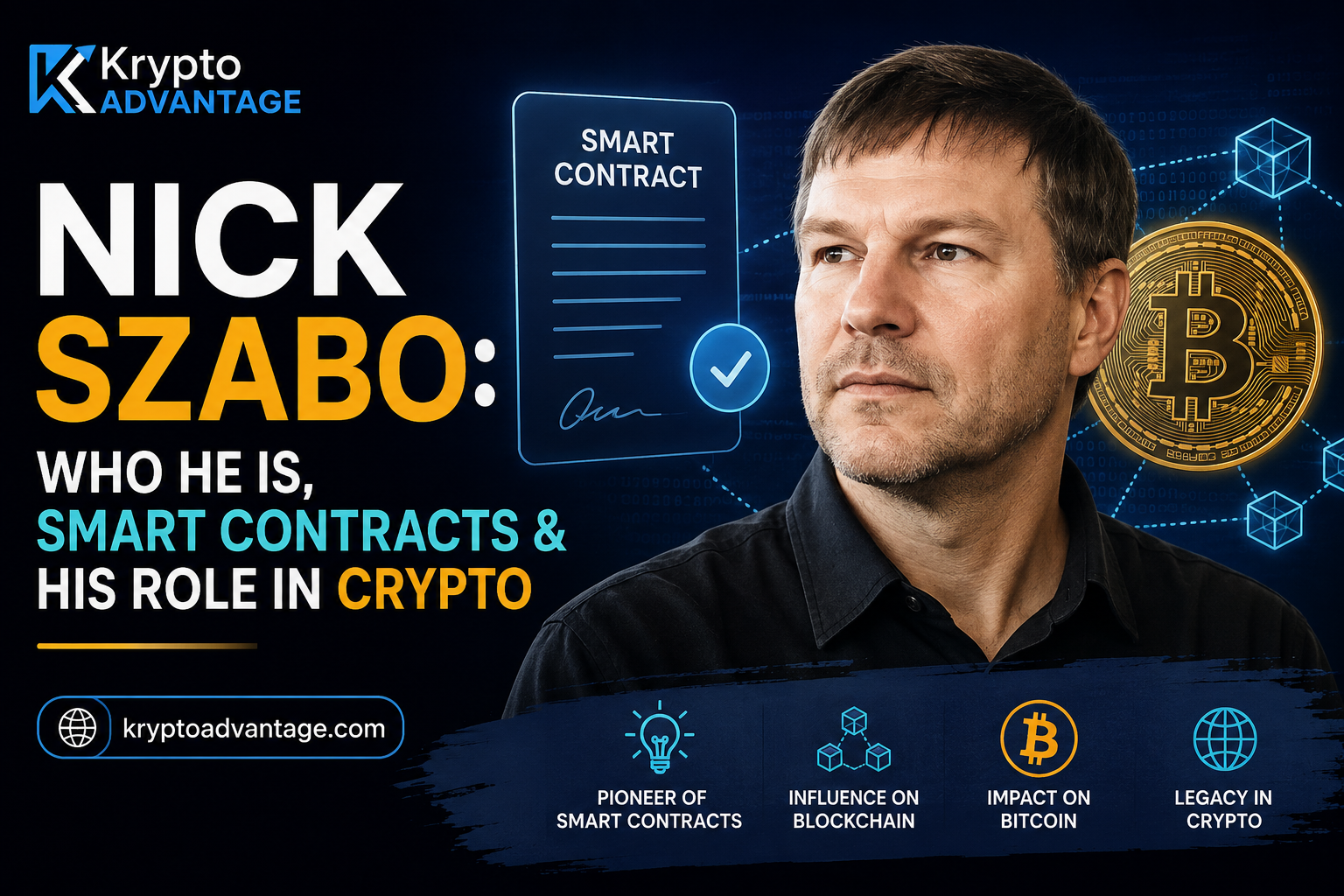
Who Is Nick Szabo?
This article explains who Nick Szabo is, what smart contracts mean, what Bit Gold was, and why his work still matters today.
Nick Szabo is an American computer scientist, legal scholar, and cryptographer. He was born on April 5, 1964, in the United States. His father had Hungarian roots and took part in the 1956 Hungarian Revolution before moving to America.
His Education and Background
Szabo earned a computer science degree from the University of Washington in 1989. He later earned a law degree from George Washington University Law School.
His background in computer science and law shaped his work. He looked at digital money as both a technical system and a way to create trust and agreements.
A Deliberately Private Life
Szabo keeps most of his personal life private and rarely gives interviews. Much of his work appears on his blog, “Unenumerated.” His essays cover history, economics, cryptography, and digital money.
Nick Szabo’s Early Work in Digital Currency
Before Bitcoin and Ethereum, several people worked on digital money. Szabo played an important role in this early movement.
Working With DigiCash
In the late 1980s, Szabo worked with David Chaum’s company, DigiCash. The company explored ways to create electronic cash.
This experience helped Szabo understand the challenges of moving money online without relying on a bank.
The Cypherpunk Connection
Szabo also took part in cypherpunk and extropian communities during the 1990s. These groups included programmers, cryptographers, and futurists who believed that cryptography could protect privacy and change how people used money and information.
Many ideas that later influenced Bitcoin came from these communities.
What Are Smart Contracts? Nick Szabo’s Big Idea
Smart contracts remain the idea that made Szabo famous. We can explain the concept in a simple way.
The Vending Machine Analogy
Szabo compared a smart contract to a vending machine. You put money into the machine, choose an item, and the machine gives you the item. You do not need a cashier or another person to complete the transaction.
A smart contract works in a similar way through software. It is a computer program that carries out an agreement when specific conditions meet the rules in the code.
Why This Idea Was Ahead of Its Time
Szabo coined the term “smart contract” in 1994. He described a system that could carry out an agreement while reducing the need for trusted middlemen.
At that time, the internet was still young, and blockchain technology did not exist. The technology needed to run smart contracts at scale came much later.
Today, smart contracts power platforms such as Ethereum. Developers use them to create lending apps, digital collectibles, and other blockchain applications.
Bit Gold: The Blueprint Before Bitcoin
In 1998, Szabo proposed Bit Gold, a theoretical design for decentralized digital money.
How Bit Gold Was Supposed to Work
Bit Gold required participants to solve difficult computer puzzles. Each solution created a unique piece of digital proof that people could not easily copy or fake.
This idea used a mechanism similar to what we now call proof of work.
Bit Gold Never Actually Launched
Bit Gold remained a theoretical proposal. Szabo never launched it as a working digital currency that people could use.
However, its design shares several similarities with Bitcoin. For this reason, many people describe Bit Gold as an important precursor to Bitcoin.
The Nick Szabo and Satoshi Nakamoto Theory
The possible connection between Nick Szabo and Satoshi Nakamoto remains one of the most discussed topics in crypto history.
Why People Suspect a Connection
Szabo’s ideas about smart contracts and Bit Gold share similarities with Bitcoin’s design. Because of these similarities, some researchers and journalists have suggested that Szabo might be Satoshi Nakamoto.
Some commentators have also compared the writing styles of Szabo and Satoshi. However, these comparisons only provide circumstantial evidence.
What Szabo Has Said
Szabo has publicly denied that he is Satoshi Nakamoto. No confirmed evidence proves that he created Bitcoin.
Satoshi’s original Bitcoin whitepaper also did not directly cite Bit Gold as a source. Therefore, the connection remains a theory rather than an established fact.
Nick Szabo’s Role in Crypto Today
Szabo’s early ideas still influence discussions about money, trust, and code.
Joining JAN3 as Chief Scientist
In January 2025, Szabo joined JAN3, a Bitcoin-focused company led by Samson Mow, as Chief Scientist.
In this role, he researches Bitcoin’s possible impact on monetary policy, international trade, and financial sovereignty. His work also builds on ideas from his essay “Shelling Out: The Origins of Money.”
Continued Relevance in the Industry
Banks and other institutions have expanded their work with tokenized assets and blockchain-based custody.
These developments use ideas similar to Szabo’s focus on reducing reliance on middlemen through code and cryptography. However, current roles and projects can change, so readers should check the latest information when needed.
Why Nick Szabo Still Matters to Beginners and Professionals
You do not need programming experience to understand why Szabo’s work matters.
For Beginners
If you have used a DeFi app, bought an NFT, or heard about smart contracts, you have seen the type of idea Szabo introduced.
Modern blockchain technology turned these early ideas into practical systems.
For Students and Professionals
Students of blockchain, computer science, and digital law can learn from Szabo’s original essays.
His work connects legal ideas with cryptography and digital money. Researchers and industry professionals still discuss these ideas today.
A Balanced Look at His Legacy
What’s well-documented: Szabo coined the term “smart contract” and designed Bit Gold. He also holds a role at JAN3, according to the information used in this article.
What’s still speculation: The Satoshi Nakamoto theory and some claims about Szabo’s exact influence on specific crypto projects remain unproven. Readers should treat these claims as theories unless stronger evidence becomes available.
Frequently Asked Questions
Who is Nick Szabo in simple terms?
Nick Szabo is a computer scientist and legal scholar. He coined the term “smart contracts” in 1994 and proposed Bit Gold in 1998. His ideas helped shape later discussions about Bitcoin and blockchain technology.
Is Nick Szabo Satoshi Nakamoto?
No confirmed evidence proves that Nick Szabo is Satoshi Nakamoto. Szabo has repeatedly denied the claim. The theory comes mainly from similarities between his work and Bitcoin’s design.
What is Nick Szabo famous for creating?
Szabo is best known for the concept of smart contracts and his Bit Gold proposal. Bit Gold remained a theoretical project and never became a live digital currency.
Did Nick Szabo create Bitcoin?
No. Satoshi Nakamoto launched Bitcoin in 2008. However, Szabo’s earlier work on Bit Gold and digital scarcity shares important ideas with Bitcoin.
What is Nick Szabo doing now?
According to the information in this article, Szabo serves as Chief Scientist at JAN3 and researches Bitcoin’s role in global trade and monetary policy. Since roles can change, readers should check the latest information for updates.
Conclusion
Nick Szabo may not have the same level of public attention as some other crypto figures, but his ideas played an important role in the development of cryptocurrency.
His work on smart contracts and Bit Gold helped shape discussions about digital money, blockchain technology, and trust. Learning about Nick Szabo can help beginners understand why modern blockchain systems work the way they do.
If you want to learn more, explore how smart contracts work on Ethereum and how Bitcoin uses proof of work.
Disclaimer: This article is for educational and informational purposes only. Some details, especially claims about the Satoshi Nakamoto theory and current professional roles, may involve speculation or change over time. Always check reliable and current sources for the latest information.