
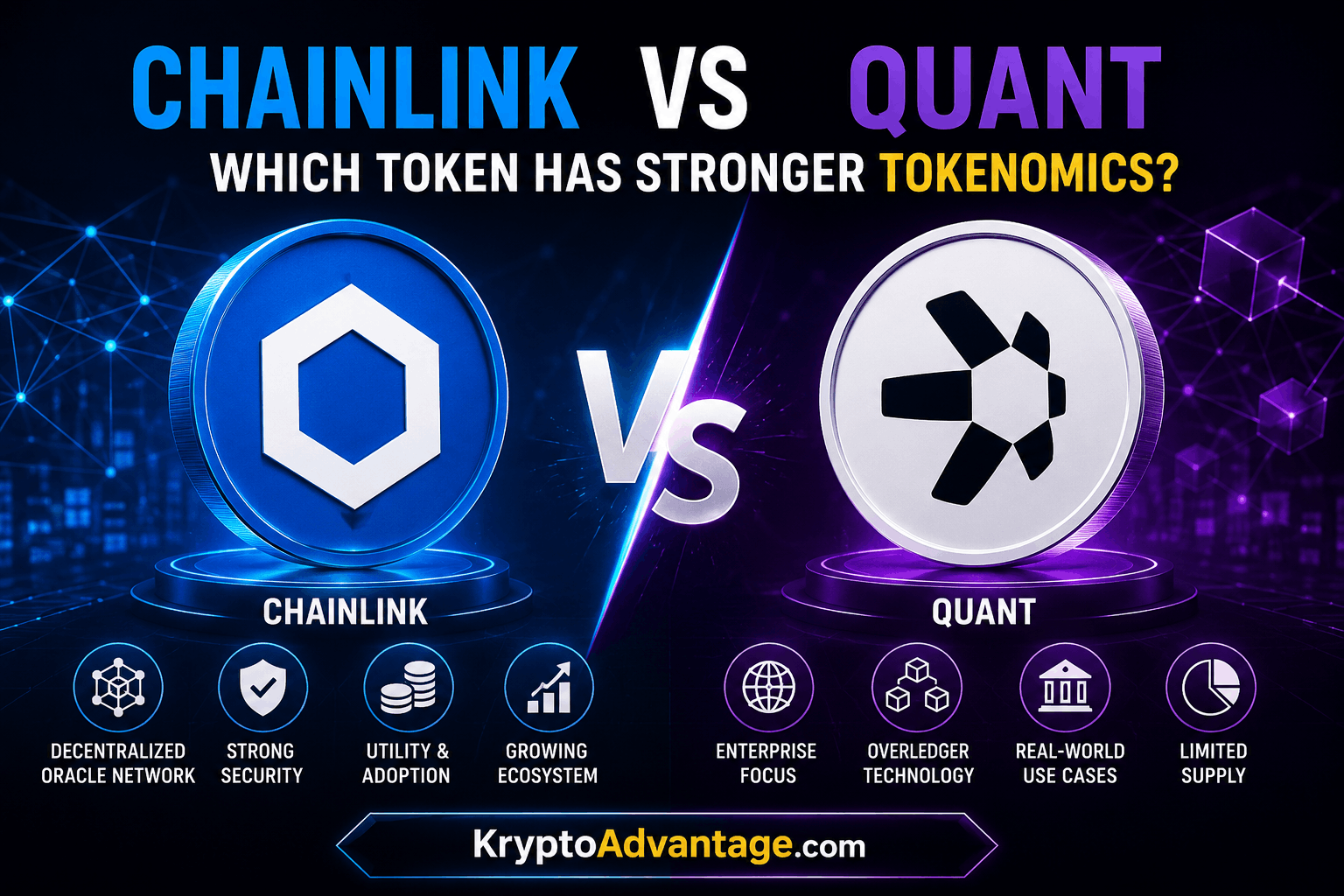
Two tokens. Two totally different money systems. If you have ever tried to compare Chainlink and Quant, you already know the numbers don’t line up in any simple way.
LINK has a billion-token supply. QNT has under 15 million. So which design actually holds up better over time?
This is the real question behind chainlink vs quant debates in crypto forums, Discord servers, and YouTube comment sections. It is not really about hype. It is about how each token is built, and whether that design supports long-term value.
In this article, we will break down both tokens piece by piece. Supply, staking, burns, locking, and institutional adoption. By the end, you will have a clear, honest answer, not a hyped-up sales pitch.
Chainlink Overview
Chainlink is the token behind the biggest oracle network in crypto. Think of an oracle as a messenger. It carries real-world data, like stock prices or weather reports, onto a blockchain so smart contracts can use it.
Without oracles, smart contracts would be stuck. They could not see prices, sports scores, or anything happening outside their own blockchain. Chainlink solved that problem early, and it now powers a huge share of DeFi price feeds.
LINK, the token, is not just for trading. Node operators use it as payment for running Chainlink’s data feeds. It is also used for staking, which we will get into shortly.
Chainlink launched in 2017 and has since become one of the most integrated projects in crypto. It works with major DeFi platforms and has been exploring partnerships with traditional finance players like SWIFT and several large banks.
If you are new to how tokens earn passive rewards, this guide on high-yield crypto staking platforms is a useful starting point before you dive into LINK staking specifics below.
Quant Network Overview
Quant Network takes a different approach. Instead of feeding data into blockchains, it connects blockchains to each other and to old-fashioned enterprise systems.
Its product, called Overledger, works like a universal translator. It lets a bank’s internal software talk to Ethereum, or lets one blockchain talk to another, without needing custom code for every single connection.
This matters because banks and governments do not want to rebuild their entire tech stack to use blockchain. Quant lets them plug in instead. That is why Quant has leaned so heavily into enterprise and government partnerships, including work tied to the Bank of England’s digital currency research and tokenized deposit pilots with major UK banks.
QNT is the access key for this system. Enterprises must lock QNT to license the Overledger platform, and developers need it to build cross-chain apps. Founded by cybersecurity veteran Gilbert Verdian in 2018, Quant has stayed smaller and more focused than Chainlink, but its niche is a real one.
For readers who want the basics of how blockchains connect and communicate in the first place, this refresher on blockchain fundamentals will help before you compare LINK and QNT further.
Chainlink (LINK) Supply & Token Utility Breakdown
Let’s get into the numbers, since this is where most of the chainlink vs quant confusion starts.
Max Supply and Circulating Supply
LINK has a hard cap of 1 billion tokens. No more can ever be minted. As of 2026, roughly 700 to 750 million LINK are already in circulation, meaning most of the supply is unlocked and trading on the open market.
That remaining chunk still matters. Large allocations went to the Chainlink team and to node operators early on, and some of those tokens continue to enter circulation over time. This is a real dilution factor worth watching, even though the release pace has slowed compared to Chainlink’s early years.
What LINK Is Actually Used For
LINK is not just a speculative asset sitting in a wallet. Node operators are paid in LINK for delivering accurate data. They also stake LINK as a security deposit, which can be slashed if they misbehave.
Chainlink also runs an official staking program open to regular token holders, not just node operators. Staked LINK earns rewards, and the pool has stayed near capacity for extended periods, which shows real demand to lock tokens rather than sell them.
More recently, Chainlink has directed a portion of protocol fees toward buying LINK on the open market through a mechanism often called the “Chainlink Reserve.” This is a newer development, and its long-term scale is still relatively modest compared to total market cap, but it is a meaningful shift toward tying real usage to token demand.
The Dilution Risk
Here’s the honest part. Because Chainlink still has hundreds of millions of LINK that could enter circulation from team and ecosystem wallets, some investors worry about steady sell pressure. This is the biggest knock against LINK’s tokenomics, even though the release schedule is public and predictable.
Quant Network (QNT) Tokenomics & Deflationary Model
Now let’s flip to Quant, where the supply story looks completely different.
A Tiny, Mostly Fixed Supply
QNT’s total supply sits at around 14.6 million tokens, and almost all of it is already circulating. This is a fraction of LINK’s billion-token cap. Scarcity is baked into the design from day one.
Quant’s history actually included a one-time supply reduction. Back in 2018, unsold ICO tokens were burned, cutting the original 24 million minted down to today’s fixed figure. Since then, there has been no ongoing burn mechanism built into the protocol.
So calling QNT strictly “deflationary” today is a bit of a stretch. It is more accurate to say QNT is fixed-supply with strong locking mechanics, rather than a token that keeps shrinking through regular burns like some other projects.
How Locking Reduces Available Supply
This is where Quant gets interesting. Enterprises that want to use Overledger must pay license fees, and those fees get converted into QNT and locked in smart contracts for the length of the license, often multiple years.
Picture it like a company buying a long-term parking permit instead of paying per visit. The tokens used for that permit are locked away, out of circulation, for as long as the contract runs.
As more banks, governments, and enterprises sign on, more QNT gets locked this way. With such a small overall supply, even modest enterprise adoption can meaningfully shrink the amount of QNT actually available to trade.
The Trade-Off
QNT’s small supply cuts both ways. It supports scarcity, but it also means the token is thinly traded compared to LINK. Fewer tokens can mean sharper price swings when big holders buy or sell.
Key Differences: Max Supply, Staking, and Institutional Adoption
Let’s line these up side by side so the chainlink vs quant comparison is easy to scan.
Supply Structure
- LINK: 1 billion max supply, around 70 to 75% circulating as of 2026.
- QNT: About 14.6 million max supply, nearly all of it circulating already.
In short, LINK trades scale for slower full-circulation. QNT trades scale for near-total scarcity.
Staking and Locking Mechanics
- LINK: Formal staking program with published rewards, plus node-level staking as a security deposit.
- QNT: No formal staking program in the traditional sense. Instead, tokens get locked through enterprise licensing deals.
Both models remove tokens from active trading, just through different doors. Chainlink invites everyday holders to stake. Quant relies on enterprise contracts to do the locking.
Institutional Adoption
- Chainlink has built relationships across DeFi and has pursued traditional finance partnerships, including pilot work referencing SWIFT and various banks, plus growing use of its CCIP cross-chain messaging product.
- Quant has focused more narrowly on government and banking infrastructure, including work connected to UK tokenized deposit pilots and central bank digital currency research.
Both projects are chasing the same prize: real-world enterprise usage. However, they are approaching it from different angles. Chainlink brings data into blockchains. Quant connects blockchains and legacy systems to each other.
Market Cap and Liquidity
LINK generally carries a larger market capitalization and deeper trading liquidity than QNT, simply because of its longer track record, broader exchange listings, and larger circulating supply. QNT’s market cap is smaller, and its low float can lead to bigger price swings on lower trading volume.
Advantages and Disadvantages
No token is perfect. Here is a balanced look at where each one holds up and where it falls short.
Chainlink (LINK): Advantages
- Deep integration across almost every major DeFi protocol, which creates real, ongoing demand for its oracle services.
- A working staking program with a public track record since 2022, not just a promise.
- Strong liquidity and wide exchange availability, making it easy to buy or sell without major price impact.
- Growing use of CCIP for cross-chain messaging, plus early steps toward fee-funded token buybacks.
Chainlink (LINK): Disadvantages
- A large share of total supply still sits with the team and ecosystem funds, which creates ongoing dilution risk.
- The recent buyback mechanism is still small relative to Chainlink’s overall market cap, so its price impact is limited for now.
- Reliance on continued DeFi and enterprise growth to keep oracle demand rising.
Quant Network (QNT): Advantages
- A small, mostly fixed supply that creates natural scarcity.
- Real enterprise use cases, including work tied to UK banking and CBDC pilots, that lock tokens out of circulation.
- Low reliance on speculative trading volume, since much of its demand comes from license agreements, not swing trading.
Quant Network (QNT): Disadvantages
- Much lower liquidity than LINK, which can lead to sharper price swings.
- No ongoing burn mechanism, so calling it “deflationary” overstates what actually happens today.
- Heavy dependence on enterprise and government adoption, which tends to move slower than retail crypto trends.
- A high concentration of tokens in early team and backer wallets, which is worth watching for any large-scale sell-offs.
Which Crypto Is Better, LINK or QNT?
There is no universal “better” here. It depends on what you value.
If you want a token with proven staking infrastructure, deep liquidity, and heavy use across the entire DeFi ecosystem, Chainlink’s tokenomics offer more transparency and a longer history to study.
If you want extreme scarcity and a token whose available supply shrinks as enterprise deals get signed, Quant’s fixed, tightly-held supply is the more aggressive scarcity play, though with more limited liquidity and a narrower use case.
Neither answer is wrong. They are simply different bets on how blockchain infrastructure gets adopted.
FAQ
Is LINK or QNT a better long-term investment?
Neither token comes with a guarantee, and prices depend on far more than tokenomics alone. LINK offers more liquidity and a longer adoption track record, while QNT offers tighter supply and a more concentrated enterprise bet. Always research current data before deciding.
Does Quant burn QNT tokens regularly?
No, not on an ongoing basis. Quant burned unsold tokens once during its 2018 ICO, which set the current fixed supply. Since then, supply reduction mostly happens through locking, not scheduled burns.
Can Chainlink’s LINK supply still increase?
The 1 billion token cap is fixed and cannot be raised. However, a portion of that supply, held by the team and ecosystem funds, has not yet entered circulation, so circulating supply can still rise over time.
Why does Quant have such a small supply compared to Chainlink?
Quant’s founders chose a small fixed supply from the start, and a one-time 2018 burn reduced it further. Chainlink chose a much larger billion-token cap to support wide distribution across node operators and a large staking ecosystem.
Is Quant’s tokenomics model considered deflationary?
It is fixed-supply rather than actively deflationary. There is no recurring burn mechanism today. Its scarcity comes mainly from enterprise licensing deals locking tokens away, not from tokens being destroyed on a regular basis.
Conclusion
When you weigh chainlink vs quant on tokenomics alone, both projects make a real case. Chainlink leans on scale, staking, and a growing role in both DeFi and traditional finance. Quant leans on scarcity, tight supply, and steady enterprise locking.
Numbers and supply caps only tell part of the story, though. Prices, adoption rates, and partnerships shift constantly in crypto. Before putting real money into either token, check current circulating supply figures, staking rates, and recent partnership news for yourself.
Which model do you trust more: Chainlink’s scale or Quant’s scarcity? That is the real question worth sitting with before you decide where to put your next dollar.
If you want to keep exploring tokenomics-driven comparisons like this one, browse more crypto analysis guides for beginner-friendly breakdowns of other major tokens.
Disclaimer
This article is for educational purposes only and is not financial advice. Cryptocurrency prices, supply figures, and staking data change often. Always verify current numbers on official sources like chain.link or quant.network and do your own research before making any investment decision.