
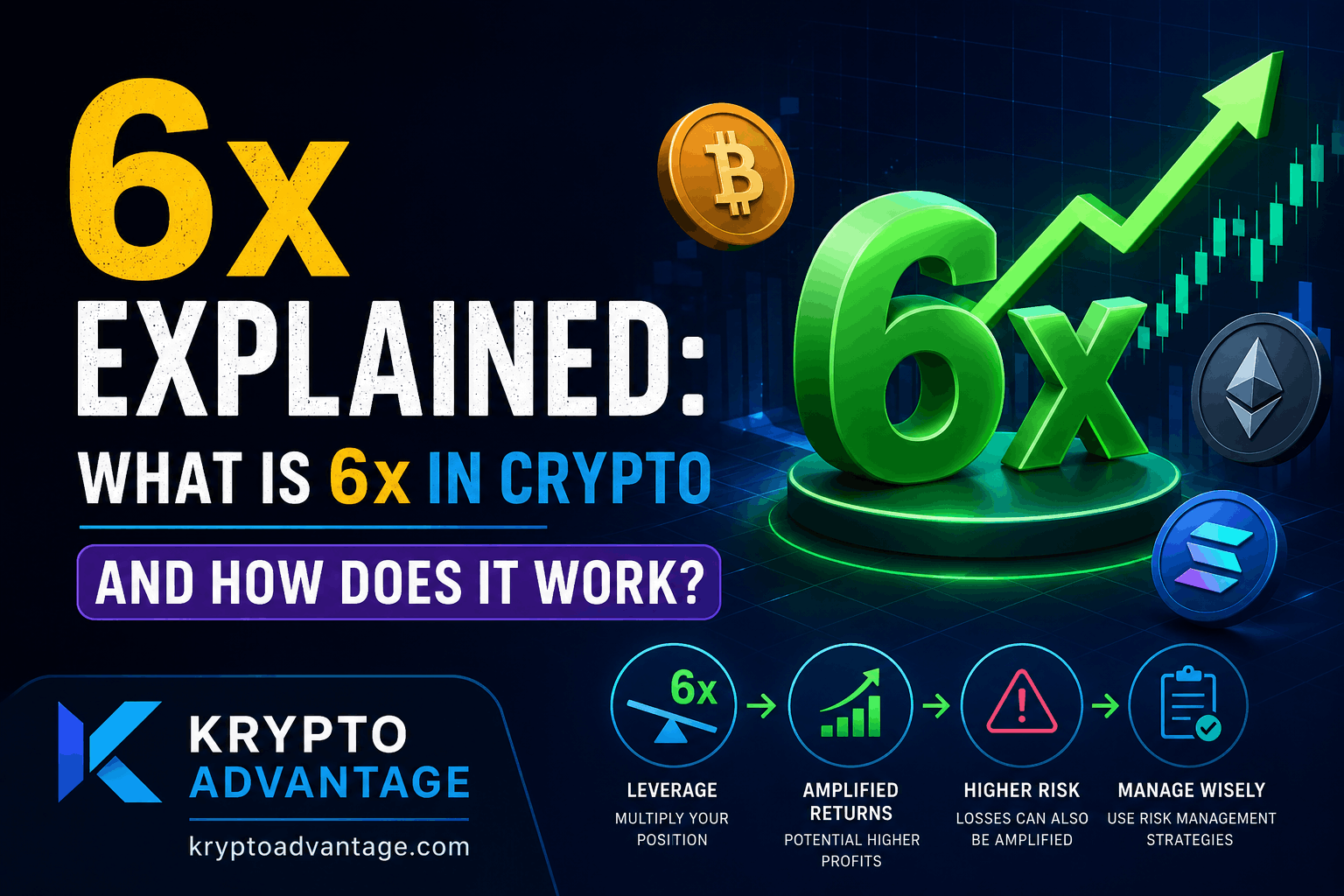
Ever come across the term “6x” while researching crypto exchanges and wondered what it actually means? You’re not alone.
The word “6x” shows up in two very different crypto conversations, and mixing them up can cause real confusion. This article breaks down both: 6x as a trading term, and 6X as an actual crypto exchange that once operated out of Singapore.
By the end, you’ll know exactly what is 6x in crypto, whether the 6X exchange is still active, and what lessons it offers anyone picking a trading platform today. If you’re new to choosing exchanges in general, our guide on how to start crypto trading with a small budget is a good companion read.
What Is 6x in Crypto? Two Different Meanings
Before going further, it helps to separate the two uses of this term. They are not the same thing, even though they look identical on paper.
6x as a Trading Term (Leverage or Growth)
In everyday crypto slang, “6x” usually describes a sixfold change in value or exposure. For example, traders say a coin “went 6x” when its price grows six times over.
The term also shows up in leverage trading. Using 6x leverage means a trader borrows funds to control a position six times larger than their actual capital. This can multiply gains, but it multiplies losses just as fast, so it is generally considered a high-risk strategy best suited to experienced traders.
6X as a Named Crypto Exchange
Separately, “6X” (also written 6x.com) was the brand name of an actual cryptocurrency exchange. It launched around 2016 and was based in Singapore.
This is the platform most people mean when they search for “6x exchange” or “6x trading platform.” Broadly speaking, a cryptocurrency exchange is a business that lets people trade digital currencies for other assets, such as regular money or other cryptocurrencies, and 6X positioned itself as exactly this type of platform. The rest of this article focuses on this specific exchange, since that’s usually what brings readers here.
What Was the 6X Exchange?
6X marketed itself as a large digital asset trading platform serving users across Asia and beyond. It offered spot trading in a handful of major cryptocurrencies.
Background and Positioning
The exchange described itself with bold language, including claims of being “Asia’s largest crypto exchange.” It reportedly ran billboard advertising in New York’s Times Square in November 2016 to build brand awareness.
Bold marketing claims like this are common across the crypto industry. They aren’t proof of scale or trustworthiness on their own, and independent exchange trackers never verified 6X’s claimed size or trading volume.
Where It Operated
6X registered its business in Singapore, a country known for hosting many cryptocurrency companies thanks to a relatively crypto-friendly regulatory environment. Still, being registered somewhere is not the same as holding an active financial license there.
The exchange said it welcomed users from many countries and did not explicitly bar US-based traders. That said, it also did not publish the kind of detailed compliance or licensing information that regulated exchanges are typically expected to disclose.
How Did 6x Crypto Exchange Work?
Understanding how 6x crypto trading functioned helps explain both its appeal and its shortcomings.
Account Setup and Trading View
Like most centralized exchanges, 6X required users to create an account and verify their identity before trading. Once inside, the platform displayed a fairly standard trading dashboard.
This included a live price chart, an order book showing current buy and sell orders, and buy/sell boxes. This layout is common across the crypto exchange industry, so it would not have felt unfamiliar to anyone who has used platforms like Binance or Coinbase.
Supported Coins and Markets
The exchange kept its coin selection fairly limited, listing around 23 tokens. This included its own native token, XT, alongside a small number of core markets such as BTC, ETH, and USDT.
That is a small selection compared to major exchanges today, which often list hundreds of coins. A limited token list is not automatically a bad sign, but it does narrow trading options significantly.
The OTC Desk Feature
One of the more notable 6x exchange features was its over-the-counter (OTC) trading desk. An OTC desk lets traders execute large orders directly, without placing them on the public order book.
This matters because large trades placed on a regular exchange can move the price against the trader, a problem known as slippage. An OTC desk is designed to help avoid that by matching big buyers and sellers privately.
6x Exchange Fees: What Did It Cost to Trade?
Fees are one of the first things any trader checks before joining a platform, and 6X was no exception.
Standard Trading Fees
6X charged a trading fee of 0.1% per transaction, which sat in the middle range compared to other exchanges operating at the same time. It was neither the cheapest nor the most expensive option available in that period.
Fee structures across the crypto industry change often and vary widely by exchange and trade volume, so this figure should be treated as historical context rather than a current, live rate.
Hidden Costs to Watch For
Beyond the base trading fee, it is always worth checking any exchange for withdrawal fees, deposit charges, and inactivity fees. Public reviews of 6X did not flag major complaints about hidden fees specifically.
However, the bigger concern with 6X was not its pricing. It was security and transparency, which matter just as much as cost when deciding where to keep your funds.
6x Exchange Review: Advantages and Disadvantages
Weighing what the platform did well against where it fell short gives a clearer, more balanced picture.
Advantages
- Familiar trading layout — the chart, order book, and buy/sell interface followed standard exchange conventions, so it was easy to pick up.
- OTC desk access — useful for traders wanting to execute large orders without disturbing the public market price.
- Mid-range fees — its 0.1% trading fee was competitive for the period, not an outlier on either end.
- No blanket ban on US users — the exchange did not explicitly exclude traders based in the United States.
Disadvantages
- Minimal team transparency — only one team member, a Vice President named Vanessa Koh, was publicly named on the site, with no visible founders or technical leadership.
- Unverified scale claims — statements like “Asia’s largest crypto exchange” were never confirmed by independent trackers.
- Basic security setup — account protection relied on just a password and two-factor authentication, with no mention of insurance or cold storage practices.
- Small coin selection — around 23 tokens, far fewer than most competitors offer today.
- No formal shutdown notice — the exchange went inactive without any public announcement, leaving users with little warning.
Is 6X a Legitimate Crypto Exchange?
This is probably the most important question for anyone researching this platform.
Red Flags Reviewers Found
Independent review sites that examined 6X in the past, including a detailed breakdown by Cointelligence, raised several concerns, most notably around its limited disclosure of leadership. Legitimate, well-established exchanges usually disclose their leadership team, company structure, and licensing details clearly, which 6X largely did not do.
Security Concerns
Account security on 6X relied on just a login password and two-factor authentication. There was no mention of fund insurance, cold storage practices, or a dedicated security team, features that reputable exchanges typically advertise prominently.
The Verdict
Based on available information, 6X displayed several of the classic warning signs associated with less trustworthy platforms: unverified scale claims, minimal team transparency, and thin security disclosures. That does not automatically mean it was fraudulent, but it does mean caution was warranted, and it’s a pattern worth recognizing on any exchange you evaluate today.
Is 6X Exchange Still Active?
Here’s the most current and practical part of this article.
As of October 2026, 6X exchange is no longer active. Available historical records indicate that the platform’s website stopped responding around March 2021, with no meaningful trading activity or official shutdown announcement reported since then.
This pattern, going quiet without a formal explanation, is unfortunately common among smaller crypto exchanges. It is very different from a planned shutdown, where a company typically gives users advance notice and time to withdraw funds.
If you still have funds tied to an old 6X account, recovery may be difficult because the platform is no longer operating. This also highlights why traders should avoid leaving funds on inactive exchanges and should act quickly when withdrawals or communication become unreliable.
Lessons From the 6X Story
The rise and quiet disappearance of 6X offers a useful case study for anyone in crypto trading today.
Check for Regulatory Licensing
Before trusting any exchange with your money, look for clear, verifiable regulatory licensing in a real jurisdiction. Simply being “registered” in a country is not the same as being licensed and supervised by a financial regulator.
Look for Team Transparency
Reputable platforms are generally open about who runs them. If an exchange hides its founders or leadership, treat that as a serious caution sign, not a minor detail.
Never Ignore Inactivity
If an exchange stops updating its app, delays withdrawals, or goes quiet on social media, do not wait around. Move your assets somewhere safer first, and ask questions later. Our roundup of established staking and trading platforms is a useful reference point for what more transparent, active platforms typically look like.
FAQ: Common Questions About 6x in Crypto
What is 6x in crypto trading specifically?
In trading slang, 6x usually refers to a sixfold price increase or 6x leverage on a position. Separately, “6X” was also the name of a Singapore-based crypto exchange that operated from around 2016 until it appears to have gone offline.
How does 6x crypto exchange work?
The 6X exchange used a standard trading dashboard with charts, an order book, and buy/sell tools, similar to most centralized exchanges. It supported a limited number of coins and offered an OTC desk for larger trades.
Is 6x a legitimate crypto exchange?
Public reviews raised concerns about limited team transparency and thin security disclosures, both common red flags in crypto. There is no confirmed evidence it was an outright scam, but it did not meet the transparency standards of major regulated exchanges.
Is 6x exchange still active today?
No. As of October 2026, 6X exchange is no longer active. Historical records indicate that its website became inactive around March 2021, with no meaningful trading activity or official communication reported since then.
Should I trust a crypto exchange with limited team information?
Generally, no. Established exchanges disclose their leadership, licensing, and security practices openly, and missing this information is a strong reason to research further before depositing funds.
Final Thoughts
So, what is 6x in crypto? It depends on context: sometimes it’s simple trading slang for a sixfold move, and sometimes it refers to the 6X exchange from Singapore, which is no longer active as of October 2026. Either way, the bigger takeaway is this: always check an exchange’s team, licensing, and security setup before you trust it with your money.
Disclaimer
This article is for general informational and educational purposes only and does not constitute financial, investment, or trading advice. Cryptocurrency trading carries significant risk, including the potential loss of funds. The 6X exchange referenced in this article is not affiliated with, endorsed by, or promoted by this website. Always do your own research and consult a licensed financial advisor before making investment decisions.