
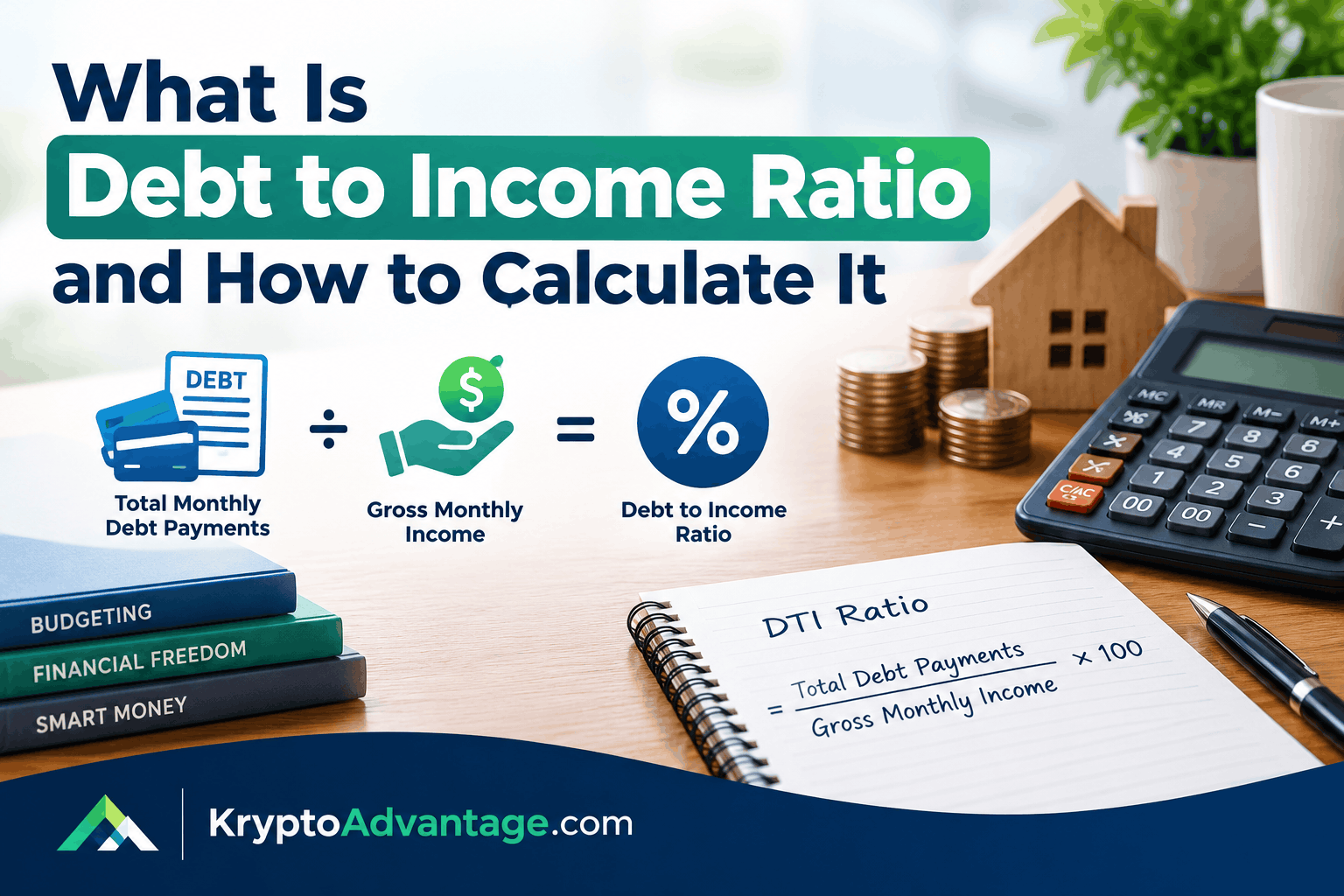
When you apply for a loan, lenders want to know whether you can afford another monthly payment. Your salary alone does not tell the whole story. They also need to understand how much of your income already goes toward existing debts.
That is where your debt-to-income ratio comes in. This figure, commonly called DTI, helps show how much of your gross monthly income goes toward paying debt. Lenders may use it when reviewing mortgage, auto loan, and personal loan applications.
The good news is that you can calculate your DTI with a simple formula. Once you know your ratio, you can better understand your borrowing position, identify potential problems, and make a plan to reduce your debt burden.
What Is Debt to Income Ratio?
Your debt-to-income ratio is the percentage of your gross monthly income that goes toward qualifying monthly debt payments. Gross income means your earnings before taxes and other deductions.
For example, suppose you earn $5,000 per month before taxes and pay $1,500 toward debts each month. Your debt-to-income ratio is 30%.
A lower DTI generally means that less of your income is committed to debt payments. A higher DTI means that more of your income is already tied up in existing obligations.
Lenders use this information to help assess whether you can manage a new payment alongside your current debts. However, DTI is only one part of a lending decision. Your credit history, income stability, savings, and the type of loan you want can also matter.
How to Calculate Your Debt to Income Ratio
You do not need complicated software to calculate your DTI. You only need your qualifying monthly debt payments and your gross monthly income.
The debt-to-income ratio formula is:
DTI = (Total Monthly Debt Payments ÷ Gross Monthly Income) × 100
Follow these three steps to work out your ratio.
Step 1 Add Your Monthly Debt Payments
Start by listing the monthly debt obligations that apply to your calculation. These commonly include:
- Mortgage payments
- Car loan payments
- Student loan payments
- Credit card minimum payments
- Personal loan payments
- Other qualifying loan payments
For a mortgage application, you may also need to include the proposed housing payment, property taxes, homeowners insurance, and applicable housing association charges.
The exact payments included depend on the lender’s rules and the type of loan.
Step 2 Calculate Your Gross Monthly Income
Use your income before taxes and other deductions.
If your annual salary is $60,000, your gross monthly income is:
$60,000 ÷ 12 = $5,000
If you earn commissions, bonuses, self-employment income, or money from other sources, check whether the lender accepts that income and what documentation it requires.
Step 3 Divide Debt Payments by Income
Suppose your qualifying monthly debt payments total $1,500 and your gross monthly income is $5,000.
$1,500 ÷ $5,000 = 0.30
Multiply the result by 100 to convert it into a percentage.
0.30 × 100 = 30%
Your debt-to-income ratio is 30%.
This means 30% of your gross monthly income goes toward the debt payments included in the calculation.
Debt to Income Ratio Example
Let’s use a more detailed example to see how several monthly payments affect your DTI.
| Monthly payment | Amount |
|---|---|
| Mortgage | $1,200 |
| Car loan | $300 |
| Student loan | $200 |
| Credit card minimum payments | $100 |
| Total monthly debt | $1,800 |
| Gross monthly income | $6,000 |
Now apply the formula:
$1,800 ÷ $6,000 × 100 = 30%
The result is a 30% DTI.
Notice that the calculation uses monthly debt payments, not the total outstanding balances on your loans. It also uses gross income rather than the amount deposited into your bank account after deductions.
If you are applying for a new mortgage, make sure the calculation includes the proposed housing payment and other costs required by the lender.
What Is a Good Debt to Income Ratio?
A lower DTI is generally better because it leaves more of your gross income uncommitted to existing debt payments. However, there is no single percentage that guarantees loan approval with every lender.
For mortgage planning, a DTI below 36% is often used as a useful target. Some borrowers can qualify with higher ratios, depending on the mortgage program, lender requirements, and their overall financial profile.
Here is a general guide to understanding different DTI levels.
| DTI ratio | What it may indicate |
|---|---|
| Below 20% | A relatively small share of gross income goes toward debt |
| 20%–35% | Debt payments may leave more room for other financial needs |
| 36%–43% | Existing debt takes a larger share of income; lender requirements become especially important |
| Above 43% | Some borrowing options may become more limited, depending on the loan |
These ranges are illustrative, not universal lending standards. A ratio that works for one loan program may not meet another program’s requirements.
Your budget also matters. Someone with a 25% DTI and high essential expenses may have less money available than someone with the same ratio and lower living costs.
Can You Get a Loan With a High DTI?
Yes, it may be possible. Some lenders and loan programs accept higher DTI ratios when other parts of an application support approval.
For example, a borrower may have stable qualifying income, substantial savings, or other strengths that help meet a particular program’s requirements.
However, a higher ratio can make borrowing more difficult. Before applying, ask the lender which DTI limits apply to your loan and whether it counts all your current obligations.
Do not take on additional debt simply because a lender may approve it. Make sure the proposed payment fits your actual budget.
Front-End vs Back-End Debt to Income Ratio
Mortgage lenders may evaluate two different DTI figures. Understanding the difference can help you prepare for a home loan application.
What Is Front-End DTI?
Front-end DTI measures qualifying housing costs against gross monthly income.
Depending on the mortgage program, these costs may include:
- Mortgage principal and interest
- Property taxes
- Homeowners insurance
- Mortgage insurance, when applicable
- Homeowners association fees, when applicable
Suppose your qualifying monthly housing costs are $1,400 and your gross monthly income is $5,000.
$1,400 ÷ $5,000 × 100 = 28%
Your front-end DTI is 28%.
What Is Back-End DTI?
Back-end DTI measures all qualifying monthly debt obligations against gross monthly income. It includes the housing costs used in the calculation and other qualifying debts, such as car loans, student loans, and credit card minimum payments.
Suppose your monthly housing costs are $1,400 and your other qualifying debt payments total $400. Your total monthly debt is $1,800.
$1,800 ÷ $5,000 × 100 = 36%
Your back-end DTI is 36%.
The two ratios provide different information. Front-end DTI focuses on housing costs, while back-end DTI considers the broader debt burden.
Not every lender uses both figures in the same way. Always check the requirements for your specific mortgage.
What Payments Count Toward DTI?
Knowing which payments to include is important because leaving out a qualifying debt can make your estimate inaccurate.
| Payment or expense | General treatment |
|---|---|
| Mortgage payment | Usually included |
| Auto loan payment | Usually included |
| Student loan payment | Usually included |
| Credit card minimum payment | Usually included |
| Personal loan payment | Usually included |
| Groceries and household supplies | Generally excluded |
| Electricity and internet bills | Generally excluded |
| Streaming subscriptions | Generally excluded |
| Proposed mortgage taxes and insurance | Included when required by the loan calculation |
These are general guidelines. Specific loan programs can treat certain obligations differently.
Is Rent Included in DTI?
Rent needs careful consideration because its treatment depends on the calculation and loan application.
For a mortgage to purchase a home, lenders generally focus on the proposed housing payment rather than assuming you will continue paying rent after moving into the property. For other lending situations, rent may be considered in affordability assessments or in particular DTI calculations.
Even when rent is excluded from a lender’s standard DTI formula, it remains an important household expense. Include it in your personal budget so you do not overestimate what you can afford.
How Does DTI Affect Loan Approval?
Lenders use DTI to help assess whether you can manage a new loan payment alongside your existing obligations.
A lower ratio can strengthen your application because it suggests that less of your gross income is already committed to debt. A higher ratio can raise concerns about whether another payment would stretch your finances too far.
However, lenders consider more than DTI. They may also review:
- Credit history: Your record of managing borrowed money.
- Income: Whether your earnings meet the lender’s qualifying requirements.
- Savings: Whether you have funds available for emergencies and other financial needs.
- Loan terms: The amount borrowed, repayment period, and expected payment.
- Loan program: The rules that apply to the particular product.
If you are applying with a co-borrower, the lender may assess both applicants’ qualifying income and debt payments. Ask how the lender will combine those figures.
A low DTI does not guarantee approval, and a high DTI does not automatically mean rejection. The final decision depends on the applicable lending rules and your overall application.
Does Debt to Income Ratio Affect Your Credit Score?
Your DTI and credit score measure different things. DTI compares debt payments with income, while a credit score reflects information in your credit history.
DTI is not itself a direct factor in standard credit-scoring calculations because income is not part of those calculations. However, the same financial decisions can affect both measures.
For example, paying down a credit card balance may reduce your credit utilization, which can affect your credit score. If the payment also reduces the minimum monthly obligation used by a lender, it may lower your DTI as well.
Paying off a loan may reduce your monthly debt burden, but the effect on your credit score can vary. Therefore, do not assume that every action that lowers DTI will automatically increase your score.
How to Lower Your Debt to Income Ratio
If your DTI is higher than you want, two main changes can help: reduce qualifying monthly debt payments or increase qualifying gross income.
You may need time to see a meaningful change. Choose steps that fit your finances instead of taking on new risks.
1 Pay Down Existing Debt
Start by listing your debts, balances, interest rates, and monthly payments.
If you have several debts, you can focus on the highest-interest balance to reduce interest costs or the smallest balance to build momentum. Keep making required payments on your other accounts.
Paying down a balance may reduce your required monthly payment, but not always immediately. Check how your lender calculates payments and when any change takes effect.
2 Avoid Unnecessary New Debt
A new car loan, personal loan, or other financing arrangement can increase your monthly obligations.
Before borrowing, calculate how the new payment would affect your DTI and your remaining budget. Avoid taking on debt merely because the monthly payment looks manageable at first.
3 Increase Your Qualifying Income
Higher qualifying income can lower your DTI when your monthly debt payments remain unchanged.
Depending on your circumstances, you might pursue additional work, seek a salary increase, or develop a reliable additional income source. Remember that lenders may require proof of income and may not accept every source.
4 Review Your Budget
Write down your take-home income, essential expenses, debt payments, and savings goals.
Look for recurring expenses you can reasonably reduce. You may then be able to direct more money toward paying down debt.
Cutting an expense does not directly change DTI unless it helps reduce qualifying debt payments or increase qualifying income. It can still improve your overall financial position.
5 Be Careful With Refinancing
Refinancing may change your monthly payment, interest rate, or repayment period. In some circumstances, a lower required payment can improve your DTI.
However, refinancing can involve fees and may increase the total interest you pay over time. Compare the full cost before making a decision, and do not refinance solely to make your ratio look better.
Debt to Income Ratio vs Credit Score
DTI and credit scores are both useful when assessing your financial position, but they answer different questions.
| Feature | Debt-to-income ratio | Credit score |
|---|---|---|
| Main purpose | Measures debt payments relative to income | Summarizes credit risk based on credit history |
| How it is expressed | Percentage | Numerical score |
| Main information used | Qualifying monthly debts and gross income | Factors such as payment history and credit utilization, depending on the scoring model |
| What it helps explain | How much income is committed to debt | How you have managed credit |
| Does it guarantee loan approval? | No | No |
You can have a strong credit score but a high DTI if your monthly debt payments are large relative to your income. You can also have a low DTI but a limited credit history.
That is why it is helpful to review both measures before applying for a major loan.
Common Mistakes When Calculating DTI
Small calculation errors can give you a misleading picture of your finances. Watch out for these common mistakes.
- Using take-home pay: Standard DTI calculations generally use gross income before taxes and other deductions.
- Forgetting a monthly payment: Include all qualifying debts rather than only your largest loan.
- Using loan balances instead of payments: DTI generally compares monthly obligations with monthly income.
- Counting every household expense as debt: Ordinary living expenses are generally excluded from standard DTI, but they still affect affordability.
- Assuming one threshold applies everywhere: Lenders and loan programs use different requirements.
- Ignoring the proposed loan payment: When estimating mortgage DTI, include the proposed housing payment and applicable costs.
- Assuming approval means affordability: A lender’s decision does not replace your own budget assessment.
Before applying for credit, calculate your ratio carefully and confirm the lender’s rules.
Frequently Asked Questions
What Is a 30% Debt to Income Ratio?
A 30% DTI means that 30% of your gross monthly income goes toward the qualifying debt payments used in the calculation. It may be manageable for many borrowers, but your living expenses, savings, and loan requirements also matter.
Is a 20% Debt to Income Ratio Good?
A 20% DTI generally indicates that a smaller share of your income goes toward debt than a higher ratio would. That can leave more room in your budget, although it does not guarantee loan approval or financial security.
Can I Get a Mortgage With a 45% DTI?
Possibly. Some mortgage programs and lenders may allow a 45% DTI in certain circumstances, while others may require a lower figure. The result depends on the loan program, underwriting rules, and the rest of your application.
Does Paying Off Debt Lower DTI?
It can. Paying off a debt may lower your DTI if it reduces the monthly payments included in the calculation. The effect depends on the debt, the lender’s calculation rules, and whether the required payment changes.
Is Rent Included in Debt to Income Ratio?
Rent may be treated differently depending on the calculation and loan type. When buying a home, lenders generally consider the proposed housing payment. Even if current rent is excluded from a particular DTI calculation, you should include it in your personal budget until you no longer pay it.
How Often Should I Calculate My DTI?
Calculate your DTI before applying for a major loan and whenever your income or monthly debt payments change significantly. Reviewing it every few months can also help you monitor your progress.
Final Thoughts
Your debt-to-income ratio helps you understand how much of your gross monthly income goes toward debt. You can calculate it by adding your qualifying monthly debt payments, dividing that amount by your gross monthly income, and multiplying by 100.
A lower DTI can give you more flexibility when borrowing, but there is no universal ratio that guarantees approval. Loan requirements vary, and the number does not account for every expense in your household budget.
Use DTI as one part of your financial planning. Review your debt, build a realistic budget, and make sure you can comfortably manage a new payment before taking on more borrowing.
Disclaimer
This article is for educational and informational purposes only and should not be considered financial, lending, or legal advice. DTI calculations and loan eligibility requirements vary by lender and loan type. Verify the applicable requirements with your lender or a qualified financial professional before making borrowing decisions.



One response to “What Is Debt to Income Ratio and How to Calculate It”
[…] like your estimated credit score range and income. Driveway then gives you a ballpark idea of loan terms, rates, and monthly payments you might qualify […]