What Is Iran’s Bitcoin Insurance for Hormuz Vessels?
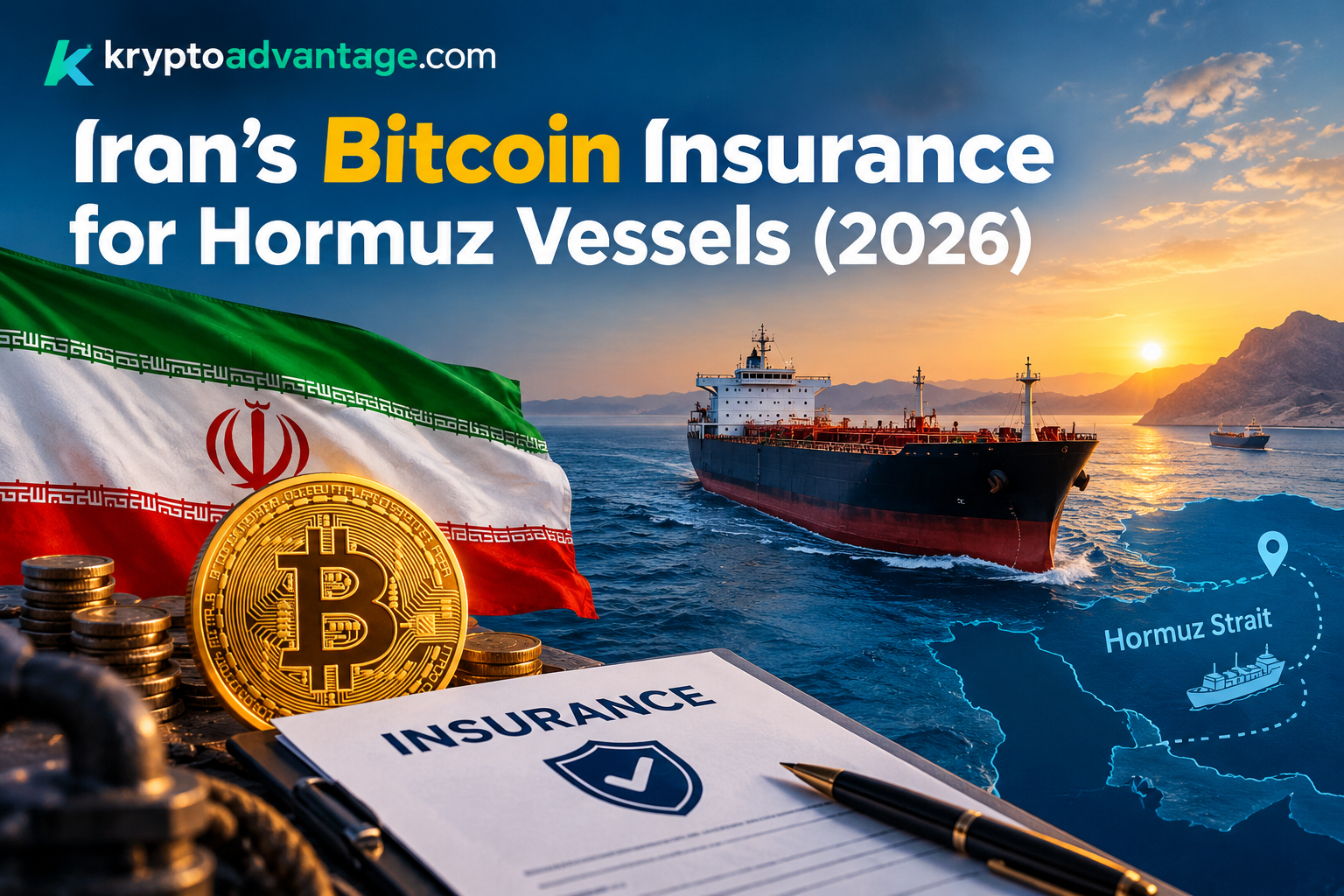
Iran’s Bitcoin insurance for Hormuz vessels is a reported digital maritime insurance service called Hormuz Safe. Reports about the platform appeared on May 18, 2026. It was presented as a way for shipping companies and cargo owners to obtain insurance for vessels passing through the Strait of Hormuz. The reported payment method includes Bitcoin and other digital assets.
The Strait of Hormuz is a major route for global oil and gas shipments. Iran’s reported insurance plan links maritime services with its efforts to manage shipping through the waterway. However, public reporting has not independently confirmed the platform’s full operations, customer numbers, or claims process.
On July 29, 2026, the US Treasury sanctioned HormuzSafe Marine Services Authority and Persian Gulf Marine Insurance Company. US officials alleged that the arrangement pressured commercial vessels into buying insurance and helped Iran generate revenue. These are official government allegations, not independent findings that establish every claim.
Understanding Hormuz Safe requires looking at its reported payment system, insurance model, revenue claims, and legal risks.
What Is Hormuz Safe and How Does It Work?
Hormuz Safe is an Iranian digital maritime insurance platform reported in May 2026. According to reports, it was introduced with support from Iran’s Ministry of Economy and Financial Affairs. The service was advertised as providing digital insurance for shipping companies and cargo owners operating around the Persian Gulf and Strait of Hormuz.
The reported process begins when a shipowner submits vessel and cargo details. The provider would then review the information, determine the applicable insurance terms, and request payment. After payment, the customer would reportedly receive a digital insurance certificate.
However, public reports have not established every step of this process. Full policy documents, exclusions, premium calculations, and claims procedures remain unclear. Independent reporting also could not confirm whether customers had purchased policies through the platform.
The US Treasury later alleged that the arrangement pressured commercial vessels into purchasing insurance. This makes it important to distinguish the platform’s advertised services from its independently verified operations.
Why Is Iran Using Bitcoin for Maritime Insurance?
Iran’s reported maritime insurance plan uses Bitcoin as an alternative payment method. The country faces extensive US sanctions that restrict many transactions involving Iranian businesses and financial institutions. Cryptocurrency can transfer value without relying on a conventional bank transfer for every payment.
However, using Bitcoin does not automatically avoid sanctions. Transactions involving designated entities can still create serious legal risks. Cryptocurrency payments may also be traced through blockchain records.
The reported insurance model could also help Iran collect revenue from shipping activity near the Strait of Hormuz. Instead of describing every payment as a direct transit fee, the arrangement presents payments as premiums for maritime services.
Iran-linked media reported that the plan could generate more than $10 billion in revenue. However, this figure has not been independently verified, and public reporting has not provided sufficient evidence of actual revenue from completed insurance transactions.
How Does the Hormuz Safe Insurance System Work?
The reported system combines digital insurance documents with cryptocurrency payments. Its proposed process involves collecting vessel information, arranging coverage, accepting payment, and issuing a digital certificate.
Bitcoin Payments and Digital Insurance Certificates
Hormuz Safe reportedly accepts Bitcoin and other digital assets for insurance payments. The platform was advertised as offering digitally verifiable policies for shipping companies and cargo owners.
Bitcoin transactions are recorded on a public blockchain. This record can help verify that a transaction occurred between particular wallet addresses. However, a blockchain transaction alone does not establish that an insurance policy is valid or that the insurer will pay a claim.
For shipping companies, the important questions include who underwrites the policy, which risks it covers, what exclusions apply, and how disputes are resolved. A digital certificate cannot replace clear contractual terms or a reliable claims process.
What Shipping Risks Does the Scheme Cover?
Reports about Hormuz Safe describe possible coverage for vessel inspections, detention, confiscation, and related shipping risks. However, these descriptions do not establish the precise protection available under an actual policy.
The extent of coverage would depend on the policy wording, exclusions, and conditions. It would also matter whether a policy covers physical damage, cargo losses, delays, or other financial losses.
The reported service should not automatically be treated as equivalent to conventional marine war-risk insurance. Standard marine policies can cover different risks depending on their terms, and additional war-risk protection may be required for vessels operating in dangerous waters.
The US Treasury alleged that the Hormuz Safe arrangement involved insurance payments linked to risks created by Iran itself. Public reporting has not independently verified the full policy terms or claims payments.
Why Is the Strait of Hormuz Important for Global Trade?
The Strait of Hormuz connects the Persian Gulf with the Gulf of Oman and the Arabian Sea. It is one of the world’s most important energy shipping routes because major oil and gas exporters depend on it to reach international markets.
According to the US Energy Information Administration, oil flows through the strait averaged approximately 20.9 million barrels per day during the first half of 2025. This represented about one-quarter of global maritime oil trade. <Link url=”https://www.eia.gov/international/analysis/special-topics/World_Oil_Transit_Chokepoints” title=”View official EIA oil transit statistics”/>.
The route is especially important for Asian energy markets. China, India, Japan, and South Korea are among the major destinations for oil transported through the region. Qatar also relies heavily on the wider Gulf shipping network to export liquefied natural gas.
A major disruption can increase freight costs, fuel expenses, and insurance premiums. Businesses may also need to find alternative shipping arrangements.
Some oil can bypass the strait through pipelines in Saudi Arabia and the United Arab Emirates. However, available alternative capacity cannot replace all the oil normally transported through Hormuz.
This strategic importance helps explain why any new insurance or payment arrangement connected to the waterway attracts international attention.
Iran’s $10 Billion Revenue Claim: What Reports Say
Iran-linked reporting in May 2026 suggested that Hormuz Safe could generate more than $10 billion in revenue. Fars News Agency reported the figure, citing information connected to Iran’s Ministry of Economy and Financial Affairs.
The reported target was linked to insurance policies and maritime services for vessels passing through the Strait of Hormuz and nearby waters. Bitcoin was presented as a payment option.
However, the $10 billion figure should not be treated as confirmed income. Public reports did not provide a detailed calculation, a clear revenue timeline, or verified transaction figures. Independent reporting also could not establish how many customers had used the platform.
Several factors could affect the scheme’s potential revenue. These include shipping traffic, insurance prices, customer participation, legal restrictions, and the level of security risk in the region.
The July 2026 US sanctions created an additional obstacle for businesses considering the service. Companies may avoid transactions that expose them to sanctions or disrupt their relationships with banks and established insurers.
The revenue claim therefore remains an unverified target reported by Iranian-linked media, rather than a confirmed financial result.
US Sanctions on Iran’s Bitcoin Insurance Scheme in 2026
On July 29, 2026, the US Treasury announced sanctions against HormuzSafe Marine Services Authority and Persian Gulf Marine Insurance Company. The action targeted entities that US officials said were involved in an Iranian maritime insurance arrangement linked to the Islamic Revolutionary Guard Corps (IRGC).
According to the Treasury, the arrangement pressured commercial vessels into purchasing maritime insurance for passage through the Strait of Hormuz. Officials also alleged that the system helped Iran generate revenue and used digital asset payments to evade sanctions.
These statements describe the US government’s allegations and enforcement position. They should not be presented as independent proof of every claim about the platform. <Link url=”https://home.treasury.gov/news/press-releases/sb0581” title=”Read the US Treasury’s July 2026 sanctions announcement”/>.
How Do US Sanctions Affect Bitcoin Insurance Payments?
US sanctions can prohibit US persons from conducting transactions with designated entities unless an authorization or applicable exception permits them. Certain transactions by foreign businesses can also create sanctions exposure, depending on the parties, activities, and relevant laws.
Using Bitcoin instead of a bank transfer does not automatically make a transaction lawful. Blockchain records can also help investigators trace payments between wallet addresses and connect transactions with other evidence.
Shipping companies should assess the identities of the parties, applicable sanctions rules, and potential effects on existing commercial relationships before considering any transaction. Qualified sanctions advice is important where the legal position is uncertain.
What Role Does the Persian Gulf Marine Insurance Company Play?
The Persian Gulf Marine Insurance Company (PGMIC) is an Iranian insurance company identified by the US Treasury as part of the reported Hormuz Safe arrangement.
According to the Treasury’s July 2026 announcement, PGMIC brokers and issues maritime insurance policies associated with the Strait of Hormuz. The Treasury also stated that the policies require approval from the Persian Gulf Strait Authority, which the United States had sanctioned.
The Treasury alleged that PGMIC and HormuzSafe Marine Services Authority formed part of a scheme designed to collect revenue from commercial vessels.
For shipowners, the distinction between advertised insurance coverage and legally usable protection is important. A policy may have limited practical value if its provider, payment arrangements, or terms create serious legal or commercial problems.
Companies should verify an insurer’s legal status, financial capacity, policy wording, and claims process before relying on its coverage.
Bitcoin Insurance vs. Traditional Marine Insurance
Bitcoin-based insurance and traditional marine insurance differ in their payment methods and the information available about their policies. The reported Hormuz Safe arrangement uses cryptocurrency payments and digital certificates, while conventional marine insurance typically operates through established insurers, brokers, contracts, and claims procedures.
Traditional marine policies can cover vessel damage, cargo losses, and other maritime risks. The actual protection depends on the insurer, policy wording, exclusions, and any additional coverage purchased.
| Feature | Reported Hormuz Safe model | Traditional marine insurance |
|---|---|---|
| Payment method | Bitcoin and other reported digital assets | Commonly bank transfers and other agreed methods |
| Policy documents | Advertised digital certificates | Formal insurance policies and supporting documents |
| Coverage details | Full terms have not been independently verified | Defined by the specific policy and its exclusions |
| Claims process | Publicly available details remain limited | Governed by the insurer’s policy and procedures |
| Legal considerations | Sanctions apply to designated entities and relevant transactions | Depends on the insurer, parties, jurisdiction, and applicable rules |
The comparison does not mean every traditional policy is reliable or that every digital insurance model is invalid. The quality of any insurance arrangement depends on its legal status, contractual terms, financial backing, and ability to pay valid claims.
In Hormuz Safe’s case, the US sanctions are an additional concern. Shipowners should not assume that a Bitcoin payment or digital certificate guarantees valid coverage or safe passage.
How Could the Scheme Affect Shipping Costs and Oil Prices?
Hormuz Safe could affect shipping costs if its use adds insurance fees, payment expenses, or delays. However, its actual pricing and customer activity have not been independently established.
Shipping costs in the Strait of Hormuz also depend on the wider security situation. Conflict, threats to vessels, and restrictions on transit can increase insurance premiums and make some shipowners avoid the route.
If vessels take longer alternative routes, they may use more fuel and require additional time to deliver cargo. These costs can affect oil shipments and other goods transported through the region.
Higher transportation costs can contribute to upward pressure on oil prices, particularly when supply is already constrained. However, oil prices also depend on global demand, production levels, inventories, and the availability of alternative routes.
The insurance scheme alone cannot determine global oil prices. Its direct economic impact remains difficult to measure without verified information about premiums, transactions, and shipping activity.
Can International Shipping Companies Use Hormuz Safe?
Hormuz Safe has advertised maritime services for vessels operating around the Strait of Hormuz. However, public reporting does not clearly establish how widely foreign shipowners have used the service.
The US sanctions against HormuzSafe Marine Services Authority and Persian Gulf Marine Insurance Company create significant compliance concerns. Foreign businesses should not assume that a transaction is safe simply because it takes place outside the United States or uses Bitcoin.
The consequences depend on the parties involved, the transaction, and the laws that apply. Shipping companies should seek qualified legal and sanctions advice before considering the service. They should also confirm whether any policy provides enforceable coverage and whether it can be used alongside their existing insurance arrangements.
What Happened After the September 2026 Crypto Sanctions?
On September 17, 2026, the US Treasury announced sanctions against BitBank, its software developer, and several associates of Iranian financier Babak Zanjani.
The Treasury alleged that BitBank had been used to transfer payments received by Hormuz Safe to Iran’s regime. It also said that Zanjani-linked businesses had facilitated large Bitcoin transfers to the IRGC. These are official US government allegations.
The announcement increased scrutiny of cryptocurrency businesses and payment networks linked to Iran. It also highlighted that digital asset transactions can remain subject to sanctions enforcement. <Link url=”https://home.treasury.gov/news/press-releases/sb0632” title=”Read the September 2026 Treasury announcement”/>.
However, the announcement does not prove that the sanctions completely stopped Hormuz Safe’s operations. Public reporting has not established the platform’s current customer numbers, transaction volume, or continuing ability to issue policies.
For shipping companies, the key issue is whether a proposed transaction involves a designated person or entity and whether applicable restrictions prohibit it. Businesses should check current official sanctions information before making decisions.
What Is the Future of Bitcoin-Based Maritime Insurance?
Bitcoin could provide an alternative payment method for some maritime insurance services. Digital records may also make it easier to verify that certain transactions occurred. However, these features do not guarantee that an insurer is reliable or that a claim will be paid.
The future of Hormuz Safe remains uncertain. Its reported launch attracted attention because it linked cryptocurrency payments with a strategically important shipping route. Yet the lack of independently verified customer activity and complete policy details limits what can be concluded about its commercial success.
For digital maritime insurance to gain wider acceptance, customers would need clear policy terms, reliable underwriting, transparent claims procedures, and confidence in the provider’s legal status. International businesses would also need to understand the regulations that apply to their transactions.
Hormuz Safe illustrates how cryptocurrency can be used in a proposed maritime payment model. It does not establish that Bitcoin-based insurance is automatically safer, cheaper, or more effective than traditional marine insurance.
Frequently Asked Questions
Does Iran Accept Bitcoin for Shipping Insurance?
Iran’s Hormuz Safe platform was reported to accept Bitcoin and other digital assets for maritime insurance. However, independent reporting has not confirmed widespread customer use.
Is Hormuz Safe Available to Foreign Shipowners?
The service was advertised for vessels crossing the Strait of Hormuz, but actual foreign customer participation remains unclear. US sanctions also create significant legal risks.
Is Iran’s Bitcoin Insurance Scheme Legal?
Its legality depends on the applicable laws and the parties involved. US sanctions restrict certain dealings with designated entities. Businesses should seek qualified legal advice before using the service.
Disclaimer
This article is for informational purposes only and does not provide financial, legal, or investment advice. Verify current information and consult a qualified professional before making decisions.