Introduction
Ever wonder who is actually winning on a prediction market, and by how much? That question is exactly what Kalscan tries to answer.
Prediction markets like Kalshi let people trade on real-world events, from sports outcomes to economic data. As these markets have grown, so has interest in seeing which traders are consistently profitable.
Kalscan is one of the newer tools built around this idea. In this guide, we’ll explain what Kalscan is, how tools like it generally work, why traders care about tracking top performers, and how this space connects to crypto. We’ll also cover a few things to keep in mind before you rely on any trader-tracking tool, including Kalscan.
What Is Kalscan?
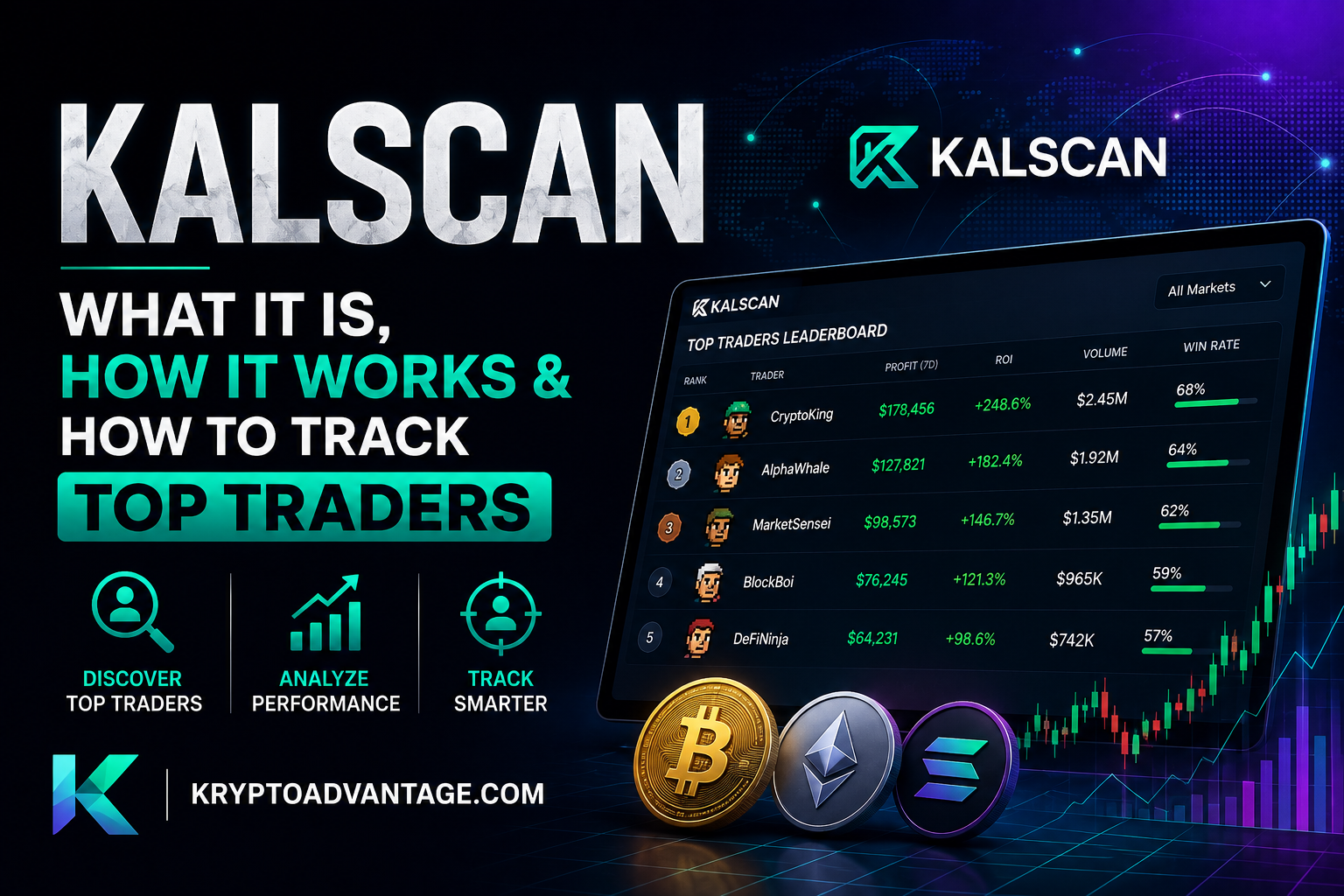
Kalscan is a web-based tool, found at kalscan.us, that describes itself as a way to track top prediction-market traders in real time on Kalshi. Its own social profile puts it simply: a leaderboard for spotting the traders performing best on the platform.
Kalshi itself is a U.S.-regulated prediction market where people trade on the outcome of real-world events, such as elections, economic reports, and sports. It has grown quickly, and its annualized trading volume has surpassed $100 billion, though a fast-moving market like this can shift, so treat any specific figure as a snapshot rather than a fixed number. If you’re new to trading concepts in general, our beginner’s guide to starting crypto trading covers the basics that carry over to prediction markets too.
A Newer, Smaller Tool
It’s worth being upfront: Kalscan is a relatively new and small project. Public information about its exact features, team, or business model is limited at the time of writing. If you’re considering using it, treat it the way you would any new trading-adjacent tool, and verify details directly on the site before trusting it with sensitive information.
How Kalscan Fits Into the Kalshi Ecosystem
Kalshi already has a built-in leaderboard feature that lets traders opt in and compete against each other. Third-party tools like Kalscan build on top of publicly available data to offer their own take on ranking and displaying top performers.
This pattern is common across trading platforms. When an exchange publishes performance data or a public leaderboard, independent developers often build separate dashboards or trackers around it. We cover similar third-party tools and app breakdowns in our App & Software Reviews section, if you want to compare how other trackers work.
How Tools Like Kalscan Generally Work
Even without every technical detail about Kalscan specifically, it helps to understand how this category of tool typically operates. Most trader-tracking platforms follow a similar pattern.
Step 1: Pulling Public Trading Data
These tools connect to a platform’s public data, such as trade feeds, leaderboard rankings, or market activity. Kalshi, for example, publishes market data and, for consenting users, leaderboard information.
Step 2: Ranking Performance
Once the data is collected, the tool sorts traders by metrics like profit and loss (PnL), win rate, or trading volume. This creates the leaderboard view that users scroll through.
Step 3: Displaying It in Real Time
The best version of these tools updates frequently, so the leaderboard reflects recent activity rather than stale numbers from days ago. This is the “real-time” promise you’ll see mentioned in Kalscan’s own description.
A Simple Analogy
Think of it like a scoreboard at a sports game. The scoreboard doesn’t play the game for you. It just shows you, at a glance, who is currently ahead, based on data pulled from the action happening on the field.
Why Traders Care About Tracking Top Performers
Watching top traders isn’t just about curiosity. There are a few practical reasons people follow leaderboards like the one Kalscan offers.
Learning From Patterns
Seeing which traders consistently rank near the top can help newer traders notice patterns, such as which types of markets tend to attract skilled, active participants.
Benchmarking Your Own Performance
If you trade on Kalshi yourself, a leaderboard gives you a reference point. It’s one thing to know your own win rate; it’s another to see how that compares to the platform’s most active traders.
Spotting Trends Early
Some traders use leaderboard and flow data to notice where attention is building on a market, which can be a useful (though not guaranteed) signal.
Kalscan and the Crypto Connection
You might be wondering why a prediction-market tool comes up in crypto conversations. The answer is that Kalshi itself has been expanding into the crypto world.
Kalshi’s Move Into Crypto and Solana
Kalshi has rolled out support for crypto deposits and has partnered with blockchain networks, including Solana and Base, to bring tokenized event contracts on-chain. This means some Kalshi markets can now be traded using crypto rails rather than only traditional payment methods.
Why This Matters for Tools Like Kalscan
As Kalshi’s onchain activity grows, tools that track trader performance become more relevant to the crypto community too. A crypto-native trader who is used to watching wallet trackers on Solana, for example, may find a similar appeal in watching a leaderboard tool for Kalshi’s tokenized markets. You can browse more on this overlap between crypto and trading tools in our Crypto & Blockchain section.
Not the Same as a Crypto Coin
One quick clarification: Kalscan, the trader-tracking tool, is not a cryptocurrency itself. It’s easy to confuse similarly named projects in this space, so always double-check the exact website and spelling before using or trusting a tool.
Advantages and Disadvantages
Like any trading-adjacent tool, Kalscan comes with trade-offs worth weighing.
Advantages
- Quick overview. A leaderboard gives you a fast snapshot of who’s performing well, without digging through raw data yourself.
- Free-to-access model (typical of this tool category). Many trader-tracking tools, including similar platforms in this space, are free to browse.
- Useful for research. Watching consistent top performers can support your own market research and learning process.
Disadvantages
- Limited public information. Because Kalscan is a newer project, there isn’t much independent, third-party verification of its accuracy or reliability yet.
- Past performance isn’t a guarantee. A trader who ranks high today may not stay there tomorrow. Leaderboards show history, not certainty.
- No substitute for your own research. Copying a “top trader” without understanding their strategy or risk tolerance can lead to losses.
How to Use a Trader-Tracking Tool Responsibly
Whether you use Kalscan or a similar platform, a few habits can help you avoid common mistakes.
FAQ
What is Kalscan used for?
Kalscan is a tool designed to track and rank top-performing traders on the Kalshi prediction market platform in real time. It works like a leaderboard, giving users a quick view of who is currently trading well.
Is Kalscan connected to Kalshi officially?
Based on available public information, Kalscan appears to be an independent, third-party tool rather than an official Kalshi product. Always check the official Kalshi website for verified, first-party data.
Is Kalscan a cryptocurrency?
No. Kalscan, as covered in this article, refers to a trader-tracking tool, not a coin or token. Always verify spelling and website addresses carefully, since similarly named crypto projects do exist.
How does Kalscan relate to crypto trading?
The connection comes through Kalshi, which has added crypto deposit support and partnered with blockchain networks like Solana and Base for tokenized prediction markets. This has made trader-tracking tools more relevant to crypto-native users.
Is it safe to rely on Kalscan’s leaderboard for trading decisions?
Treat it as one data point, not financial advice. Since Kalscan is a newer and less-established tool, it’s wise to verify any information against Kalshi’s own official data before making trading decisions.
Conclusion
Kalscan is part of a growing trend: tools that turn public trading data into an easy-to-read leaderboard. It aims to help Kalshi users spot top-performing traders in real time, and it sits at an interesting intersection between prediction markets and crypto, thanks to Kalshi’s expansion onto networks like Solana.
That said, because it’s a newer and smaller project, it’s smart to do your own homework before relying on it heavily. If you’re exploring crypto-adjacent trading tools, take the same careful, verify-first approach you’d use with any new platform.
Disclaimer: This article is for general informational and educational purposes only. It does not constitute financial, investment, or trading advice. Trading on prediction markets and cryptocurrency platforms carries real financial risk, and tool features, availability, and accuracy can change over time. Always verify current details directly with the official provider before making decisions.