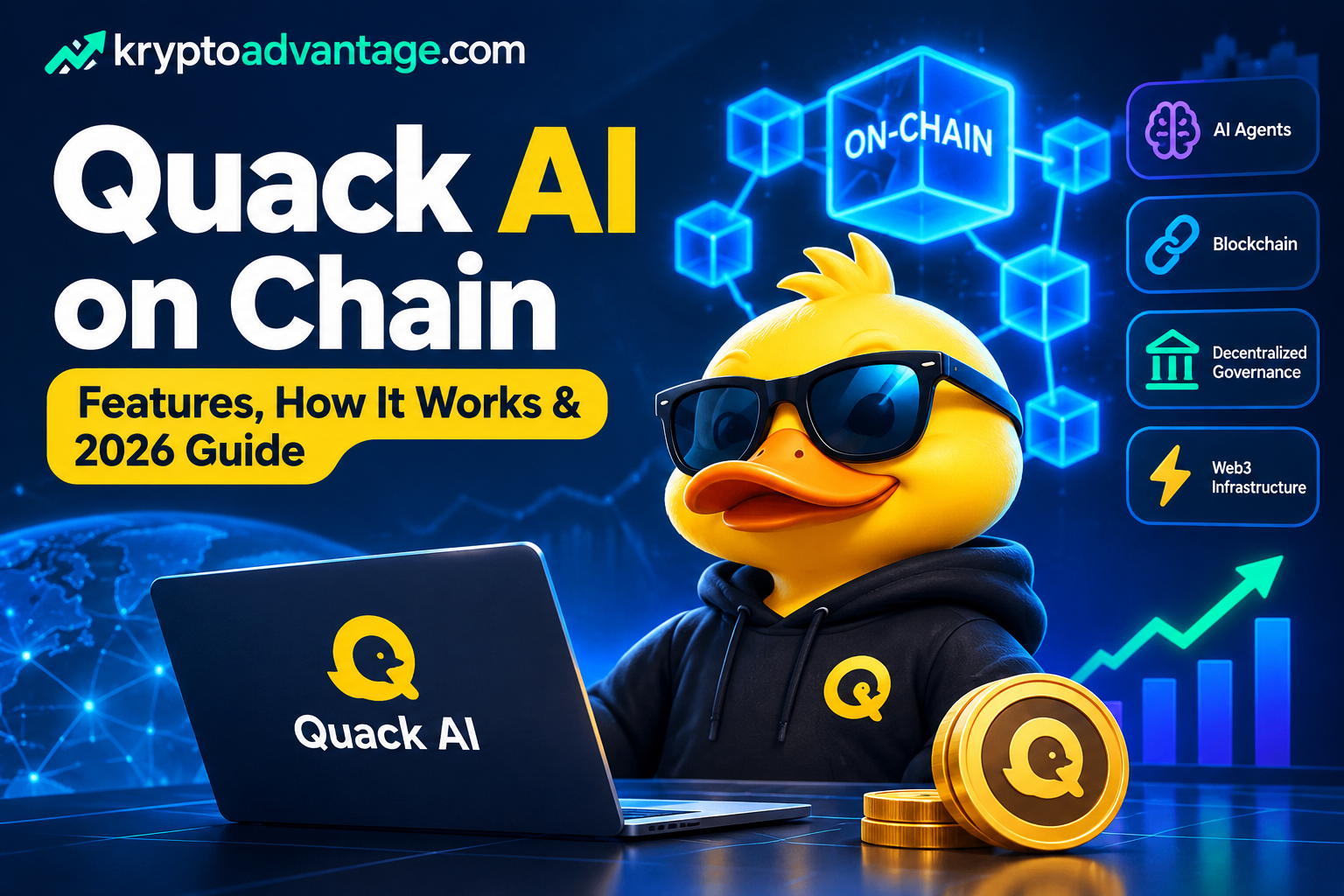
What Is Quack AI on Chain?
Quack AI is an AI governance platform for blockchain ecosystems. It helps DAOs automate voting and governance tasks. AI agents can analyze proposals and make voting decisions. Users can also delegate voting based on their preferences.
The platform supports automated execution across multiple EVM chains. Its Q402 system also enables gasless stablecoin payments. Q402 currently operates across 12 EVM mainnets. These features connect AI agents with practical on-chain actions.
How Does Quack AI Work?
Quack AI uses AI agents to handle different blockchain governance tasks. These agents can read and analyze DAO proposals. They can also recommend votes based on set user preferences.
After approval, agents can help execute governance actions on-chain. The system can also automate certain treasury management tasks. Quack AI supports these processes across multiple blockchain networks.
Its Q402 system adds gasless stablecoin payments for AI agents. A user first signs an EIP-712 authorization message. Q402 then verifies the request and submits the transaction.
Its relayer pays network gas from a funded gas pool. The stablecoin payment then settles directly on the blockchain. Q402 currently supports 12 EVM mainnets.
Quack AI Core Technology
Quack AI combines AI agents with blockchain governance infrastructure. Its agents analyze proposals and help users make voting decisions. The platform also supports delegated voting based on user preferences.
Approved decisions can then trigger on-chain actions across supported networks. Q402 provides the platform’s gasless transaction infrastructure for AI agents.
It uses EIP-712 signatures and EIP-7702 delegated authorization. Users can approve payments without spending native blockchain tokens. Q402 then relays transactions and covers the network gas.
The system also supports agentic wallets with spending limits. These wallets can use per-transaction and daily spending caps.
Q402 can process payments, batch payouts, and selected DeFi actions. These features connect AI agents with controlled blockchain transactions.
Key Features of Quack AI
Quack AI offers several tools for AI-based blockchain governance. Its AI agents can analyze proposals and support voting decisions.
Users can also delegate voting tasks to selected AI agents.
The platform can execute approved governance actions across supported networks. It also supports treasury tasks through automated agent workflows.
Q402 enables gasless stablecoin payments across 12 EVM mainnets. Users can pay with supported stablecoins without holding native gas tokens.
The system uses EIP-712 signatures and EIP-7702 delegation. It also supports agentic wallets with spending limits and batch payments.
Quack AI also supports recurring payments and cross-chain value transfers. Its tools can connect AI agents with services like MCP clients.
Governance analysis can also produce structured voting recommendations from proposals. These features help connect AI decisions with verifiable blockchain actions.
AI-Powered Governance
Quack AI uses AI agents to support blockchain governance decisions. These agents can read and analyze complete governance proposals.
They can score proposals and provide structured voting recommendations. Users can then vote manually or delegate voting power.
Delegated agents can follow the user’s chosen preferences. Approved proposals can trigger actions across supported blockchain networks.
Quack AI also connects governance with on-chain execution. This helps reduce manual steps after governance decisions pass.
Quack AI also supports AI-assisted proposal drafting and settlement flows. Its governance tools aim to make participation easier for users.
However, AI recommendations do not replace the user’s final voting choice.
AI Agent Delegation
Quack AI lets users delegate governance tasks to AI agents. These agents can vote according to selected user preferences.
Users can also create custom agents with specific community values. The agents analyze proposals before making voting recommendations.
Users can choose whether agents vote and act for them. Quack AI connects delegated voting with on-chain governance actions.
Approved proposals can move through execution across supported networks. This reduces the need for users to handle every step manually.
The system also keeps governance actions verifiable on-chain.
Q402 adds controls for agents that handle transactions. Each agent wallet can have spending limits and daily caps.
These controls help limit how much an agent can spend. Agent wallets can also use on-chain reputation checks.
On-Chain Execution
Quack AI connects governance decisions with actual blockchain actions. AI agents can help execute approved actions across supported networks.
This moves governance beyond voting into real on-chain activity. The process uses defined authorization rules before agents perform transactions.
Q402 provides the transaction layer for these agent actions. Users can authorize transactions using an EIP-712 signed request.
EIP-7702 delegation helps control what authorized agents can execute. Q402 can then submit transactions and sponsor their gas costs.
The system also supports spending limits for agentic wallets. These limits help control automated transactions and reduce unwanted spending.
Completed transactions remain on-chain and can be independently verified.
Quack AI Supported Blockchains
Quack AI supports governance and execution across multiple blockchain networks. Its Q402 payment system currently supports 12 EVM mainnets.
| Supported Blockchain | Q402 Support |
|---|---|
| BNB Chain | Yes |
| Ethereum | Yes |
| Avalanche | Yes |
| Arbitrum | Yes |
| Base | Yes |
| Mantle | Yes |
| Scroll | Yes |
| Monad | Yes |
| Injective | Yes |
| X Layer | Yes |
| Stable | Yes |
| Robinhood Chain | Yes |
Q402 uses the same payment system across these supported networks. Users can make stablecoin payments without holding native gas tokens.
The system currently supports USDC, USDT, and RLUSD. USDG is also supported on the Robinhood Chain integration.
Quack AI’s broader governance platform covers additional blockchain ecosystems. Its official FAQ lists BNB Chain, Arbitrum, Metis, and DuckChain.
Quack AI Q402 Payment System
Q402 is Quack AI’s gasless payment system for stablecoin transactions. It lets users pay without holding native gas tokens.
Users first sign an EIP-712 authorization message. Q402 then verifies the request and submits the transaction.
Its gas pool covers the network fee for each transaction. This allows users and AI agents to complete supported payments without directly paying native gas fees.
The system supports USDC and USDT across most supported networks. RLUSD works specifically on Ethereum through the current system.
USDG is supported on Robinhood Chain. Q402 also provides agent wallets with spending limits.
These limits help control automated payments made by AI agents.
Quack AI Use Cases
Quack AI can support several practical tasks across blockchain ecosystems. DAOs can use AI agents to analyze proposals and support voting.
Agents can also execute approved governance actions across supported chains. This can reduce manual work during the governance process.
Treasury management is another important use case for Quack AI. AI agents can help automate selected treasury tasks.
Q402 can enforce spending limits during automated transactions. This gives organizations more control over agent-based payments.
Quack AI also supports payments and recurring transaction workflows. Q402 allows agents to make gasless stablecoin payments across supported chains.
It can also handle batch payouts and scheduled payments. Agents can use curated DeFi lending vaults for supported assets.
The platform also supports cross-chain transfers through Chainlink CCIP. This lets agents move supported USDC between selected networks.
These features connect AI agents with real blockchain activities.
Quack AI Benefits and Risks
Quack AI can help automate several blockchain governance tasks. Its tools can analyze proposals and provide structured voting recommendations.
It can also support AI agents with on-chain actions. These features may reduce manual work for DAO participants.
The platform also supports automated treasury and governance workflows. Its Q402 system enables gasless stablecoin payments across multiple EVM chains.
Agent wallets can use spending limits and other on-chain safeguards.
However, AI-based governance still carries important risks. AI recommendations can contain errors or misunderstand complex proposals.
Automated agents may also act incorrectly without proper safeguards. Quack AI states that its governance analysis is not voting advice.
Users or their agents still make the final voting decision. Users should also consider smart contract and wallet security risks.
Automated systems can create larger consequences when permissions are too broad. Strong spending limits and approval controls can reduce these risks.
AI governance remains an emerging area within the broader blockchain ecosystem.
Quack AI 2026 Outlook
Quack AI’s 2026 roadmap focuses on smarter governance and AI agent infrastructure. Its roadmap includes intelligence, simulation, treasury, and agent economy phases.
The platform is also expanding Q402 for AI-driven on-chain transactions. Q402 currently supports gasless payments across 12 EVM chains.
It uses EIP-712 and EIP-7702 for controlled transaction authorization. Governance tools are another major focus for the platform.
Its API can analyze Snapshot proposals and provide voting recommendations. The service currently charges 0.05 USDC per analysis on Base.
The broader 2026 direction connects governance with authorization and execution. This could make AI agents more useful within DAO operations.
However, adoption will depend on security, accuracy, and real-world usage.
Quack AI FAQs
What is Quack AI?
Quack AI is an AI governance infrastructure platform for blockchain projects. It helps automate governance, voting, execution, and treasury tasks.
How does Quack AI work?
It uses AI agents to analyze proposals and support governance decisions. Users can also delegate voting and automate approved actions.
Does Quack AI support multiple blockchains?
Yes, Quack AI is designed for multichain blockchain governance. Its Q402 payment system currently supports 12 EVM mainnets.
Can users create custom AI agents?
Yes, users and protocols can create custom AI agents. These agents can follow specific governance preferences and community principles.
Can Quack AI analyze DAO proposals?
Yes, its governance tool analyzes Snapshot proposals and provides voting recommendations. The analysis includes ratings across several governance-related dimensions.
Does Quack AI make voting decisions for users?
Its analysis provides recommendations, but users keep control over voting decisions. Quack AI states that analysis does not represent financial advice.
What is Q402?
Q402 is Quack AI’s authorization and execution infrastructure. It supports gasless stablecoin payments across multiple EVM chains.
Is Quack AI secure?
Quack AI uses smart contracts, authorization controls, and on-chain verification. Users should still review permissions before using automated blockchain systems.
Disclaimer
This article is for educational purposes only. Quack AI information may change over time. Always verify details through official sources before making financial or investment decisions.