GOOGL vs GOOG: What’s the Difference? Voting Rights, Dividends & Which Is Better in 2026
If you have ever searched for Alphabet stock, you may have noticed two tickers: GOOGL and GOOG. Both belong to Alphabet Inc., the company behind Google, YouTube, and other major technology businesses.
At first, the two stocks can look like completely different investments. They have different ticker symbols and can sometimes trade at slightly different prices. However, both represent ownership in the same company.
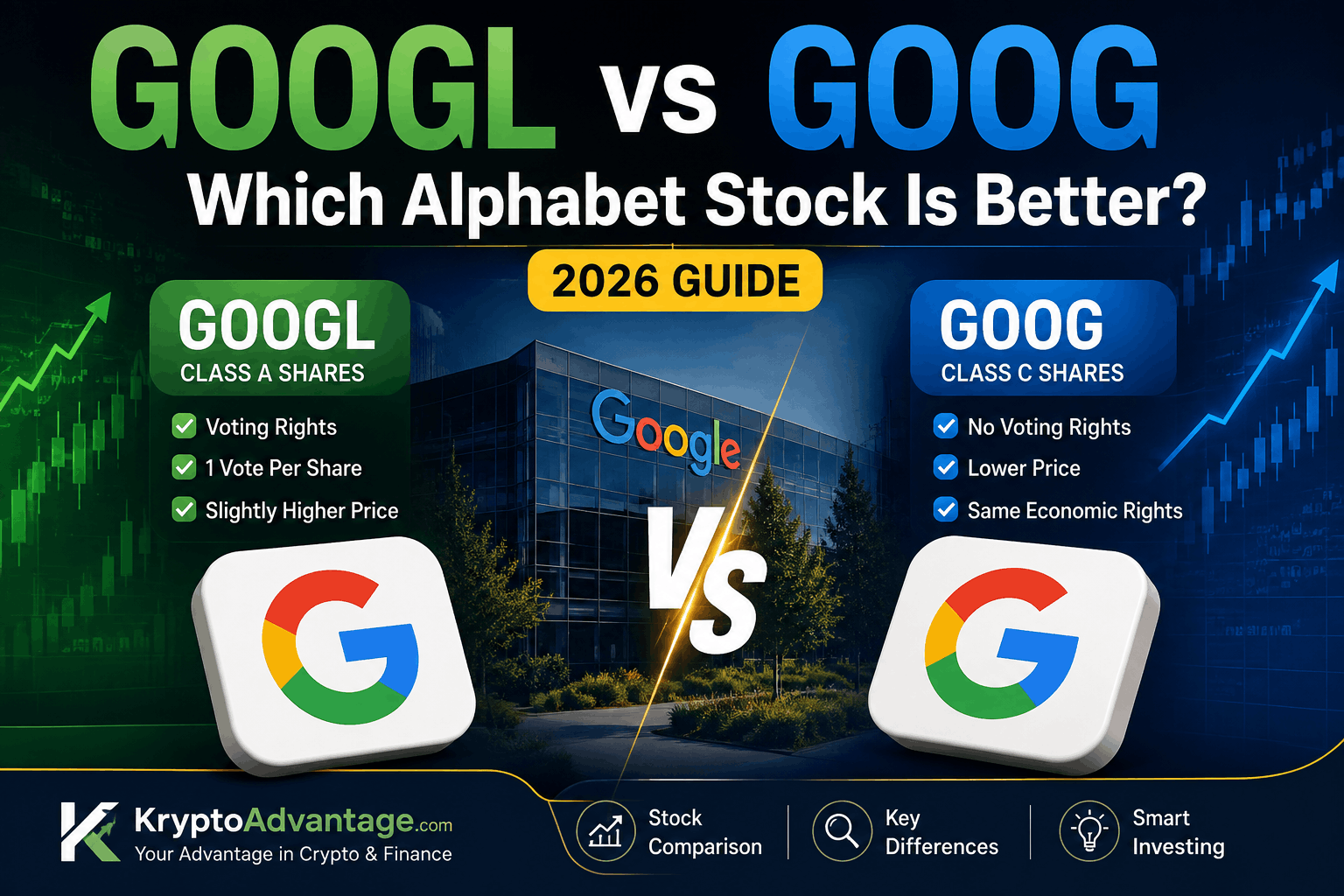
The main difference is simple: GOOGL has voting rights, while GOOG does not.
That small difference can make the choice confusing for new investors. This guide explains how the two share classes work, how their dividends compare, why their prices can differ, and what investors should know in 2026.
Note: This article is for educational purposes only and is not personalized investment advice.
What Are GOOGL and GOOG?
GOOGL and GOOG are two publicly traded share classes of Alphabet Inc.
GOOGL represents Alphabet’s Class A common stock. Each Class A share carries one vote per share.
GOOG represents Alphabet’s Class C capital stock. Class C shares do not normally carry voting rights.
Alphabet also has Class B shares. These shares carry 10 votes per share and are mainly held by Alphabet’s founders and other insiders.
This structure gives Alphabet a multi-class share system. It allows investors to own an economic interest in the company while giving certain shareholders greater voting control.
The important point is that GOOGL and GOOG are not separate companies. They are two publicly traded classes connected to the same underlying business.
Why Does Alphabet Have Two Stock Tickers?
The story goes back to Google’s decision to create a non-voting Class C share.
In 2014, Google created Class C shares and distributed them to existing shareholders through a stock dividend. The structure allowed the company to issue additional shares while helping founders maintain greater control over voting decisions.
Google later became part of Alphabet Inc. in 2015.
Today, the same basic structure remains. Investors can buy publicly traded Class A shares through GOOGL or Class C shares through GOOG.
This is why two different tickers can represent the same underlying company.
GOOGL vs GOOG: The Main Difference
The biggest difference is voting power.
GOOGL shares are Class A common stock. Each share generally provides one vote on matters submitted to shareholders.
GOOG shares are Class C capital stock. They generally have no voting rights, except where voting may be required by law.
Alphabet’s Class B shares are different again. Each Class B share carries 10 votes.
This means a retail investor buying one GOOGL share gets more shareholder voting rights than someone buying one GOOG share.
However, the practical impact of that vote can be limited for an individual investor because of Alphabet’s founder-controlled Class B structure.
GOOGL vs GOOG: Economic Rights
Although voting rights are different, the economic interests of GOOGL and GOOG are designed to be very similar.
Both classes represent an ownership interest in Alphabet. Both can benefit when Alphabet’s business grows, and both are affected by changes in the company’s financial performance and market valuation.
Alphabet also pays the same declared common-stock dividend per share across its Class A, Class B, and Class C shares.
In July 2026, Alphabet declared a quarterly cash dividend of $0.22 per share for Class A, Class B, and Class C stock.
So there is no dividend advantage simply from choosing GOOGL over GOOG.
GOOGL vs GOOG Price Difference
One of the most common questions is why GOOGL and GOOG can have different prices if they represent the same company.
The answer is mainly supply, demand, and the value investors place on voting rights.
GOOGL can sometimes trade at a premium because it includes voting rights. GOOG can sometimes trade at a discount because it does not normally include those rights.
However, there is no permanent rule saying GOOGL must always be more expensive.
The difference can change throughout the trading day. Market demand, institutional activity, trading volume, and other factors can influence the spread.
Because of that, investors should check the current market prices instead of relying on an old percentage difference.
Does GOOGL Perform Better Than GOOG?
Not necessarily.
Both share classes are tied to Alphabet’s overall business. If Alphabet’s advertising, cloud, YouTube, artificial intelligence, or other businesses perform well, both classes can benefit.
Likewise, if Alphabet faces weaker earnings, regulatory problems, increased competition, or other business risks, both share classes can be affected.
The price difference between the two classes can change over time, but that does not automatically mean one is a fundamentally better investment.
For many investors, the more useful comparison is the current price difference and whether voting rights matter to them.
GOOGL vs GOOG: Dividend Comparison
For dividend-focused investors, there is very little difference between the two.
Alphabet’s common-stock dividend applies to its Class A, Class B, and Class C shares.
The company increased its quarterly common-stock dividend from $0.21 to $0.22 per share in April 2026. Alphabet’s July 2026 filing also confirmed a $0.22 quarterly dividend for all three common-stock classes.
That means an investor holding one GOOGL share and an investor holding one GOOG share receive the same declared dividend per share.
Of course, future dividends are not guaranteed. Alphabet’s filings state that future dividend payments remain subject to approval by its board.
GOOGL vs GOOG: Voting Rights Explained
Voting rights are the clearest reason to choose GOOGL instead of GOOG.
Here is the basic structure:
| Share Class | Ticker | Voting Rights |
|---|---|---|
| Class A | GOOGL | 1 vote per share |
| Class B | Not publicly traded | 10 votes per share |
| Class C | GOOG | No normal voting rights |
Alphabet’s Class B shares are important because they give founders and other eligible insiders much greater voting power.
Therefore, owning GOOGL gives an individual investor a vote, but that does not mean the investor has significant control over Alphabet.
Still, some investors prefer having voting rights whenever the choice is available.
GOOGL or GOOG for Long-Term Investors?
There is no universal answer.
For a long-term investor, both can provide exposure to Alphabet’s business. The choice usually comes down to three things: voting rights, current price, and personal preference.
If GOOGL and GOOG are trading at nearly the same price, an investor who wants voting rights may prefer GOOGL.
If GOOG is noticeably cheaper at the time of purchase, an investor who does not care about voting rights may prefer GOOG.
The important point is not to assume that one ticker is always the better choice.
Check the live prices before buying and compare the difference between the two classes.
What Has Changed for Alphabet in 2026?
Alphabet’s share-class structure has not fundamentally changed, but the company continues to evolve rapidly.
One of the biggest themes in Alphabet’s business remains artificial intelligence. The company continues investing heavily in AI infrastructure and computing capacity.
Alphabet also remains exposed to its traditional businesses, including Google Search, advertising, YouTube, and Google Cloud.
Its financial performance can therefore affect both GOOGL and GOOG.
Another important 2026 development is Alphabet’s capital-return activity. The company has continued its common-stock dividend program and maintains authorization for share repurchases. As of June 30, 2026, Alphabet reported $69.5 billion remaining under its $70 billion Class A and Class C repurchase authorization.
These developments matter because both publicly traded share classes participate in Alphabet’s broader capital structure.
Are GOOGL and GOOG in the S&P 500?
Yes.
Both Alphabet Class A and Class C are currently listed as S&P 500 constituents.
S&P Dow Jones Indices’ August 31, 2026 data lists both Alphabet Inc A (GOOGL) and Alphabet Inc C (GOOG) among the index constituents.
This is one reason investors may already have exposure to both classes through broad-market index funds.
If you own an S&P 500 index fund, you do not normally need to choose between GOOGL and GOOG yourself. The fund’s index methodology determines its holdings.
Do Index Funds Own Both GOOGL and GOOG?
They can.
Because Alphabet has multiple publicly traded share classes, index products can hold both GOOGL and GOOG.
This is an important detail for beginners. Someone may think they only own one Alphabet stock through an index fund, while the fund may actually hold both publicly traded classes.
The exact holdings depend on the fund and its tracking methodology, so investors should check the fund’s latest holdings if this distinction matters to them.
Can You Convert GOOGL Into GOOG?
Generally, investors should not think of GOOGL and GOOG as interchangeable shares that can simply be converted whenever they want.
If you own GOOGL and want GOOG exposure, the normal approach is to sell the GOOGL shares and purchase GOOG separately.
The same applies in reverse.
Before doing this, investors should consider trading costs, taxes, and the possible consequences of selling an investment.
Which Is Better: GOOGL or GOOG?
For many investors, the difference is relatively small.
GOOGL may make more sense if:
You want voting rights.
You prefer owning Class A shares.
The price difference between GOOGL and GOOG is small.
You want the option to participate in shareholder votes.
GOOG may make more sense if:
You do not care about voting rights.
GOOG is trading at a lower price than GOOGL when you are ready to buy.
You mainly care about economic exposure to Alphabet.
There is no guaranteed winner between the two.
The better choice can depend on the current price gap and what matters to you as an investor.
GOOGL vs GOOG: Quick Comparison
| Feature | GOOGL | GOOG |
|---|---|---|
| Company | Alphabet Inc. | Alphabet Inc. |
| Share class | Class A | Class C |
| Voting rights | 1 vote per share | No normal voting rights |
| Dividend per share | Same | Same |
| Economic exposure | Alphabet | Alphabet |
| Publicly traded | Yes | Yes |
| S&P 500 | Yes | Yes |
| Main difference | Voting rights | No voting rights |
The table makes the core point clear: the biggest practical difference is voting rights, not exposure to Alphabet’s underlying business.
Frequently Asked Questions
Is GOOGL better than GOOG?
Not automatically. GOOGL provides voting rights, while GOOG generally does not. Both represent ownership in Alphabet, so the choice often depends on the current price difference and whether voting rights matter to you.
Which pays a higher dividend, GOOGL or GOOG?
Neither. Alphabet’s declared common-stock dividend is paid at the same per-share rate across Class A, Class B, and Class C shares. In July 2026, the declared quarterly dividend was $0.22 per share.
Why does GOOGL sometimes cost more than GOOG?
The market can place a value on GOOGL’s voting rights. Supply, demand, institutional trading, and other market factors can also affect the difference.
Does GOOG have voting rights?
GOOG is Alphabet’s Class C capital stock and normally has no voting rights, except where voting is required by law.
Does GOOGL have voting rights?
Yes. Alphabet’s Class A common stock generally carries one vote per share.
Are GOOGL and GOOG the same company?
Yes. Both are share classes of Alphabet Inc., the parent company of Google.
Are both GOOGL and GOOG in the S&P 500?
Yes. S&P Dow Jones Indices currently lists both Alphabet Class A and Alphabet Class C as S&P 500 constituents.
Can I buy both GOOGL and GOOG?
Yes. Both are publicly traded securities. An investor can own either or both, depending on their investment strategy.
Final Thoughts
The GOOGL vs GOOG question looks complicated at first, but the main difference is straightforward.
GOOGL represents Alphabet’s Class A shares and normally provides one vote per share. GOOG represents Class C shares and normally has no voting rights.
From an economic perspective, both provide exposure to the same Alphabet business. They also receive the same declared common-stock dividend per share.
For many investors, the decision comes down to the current price difference and whether voting rights are worth paying a little more for.
Before buying either ticker, check the latest market price, review Alphabet’s current financial information, and consider your own investment goals.
This article is for educational purposes only. It does not provide financial, investment, or tax advice. Stock prices, dividends, company results, and market conditions can change. Always conduct your own research before making an investment decision.