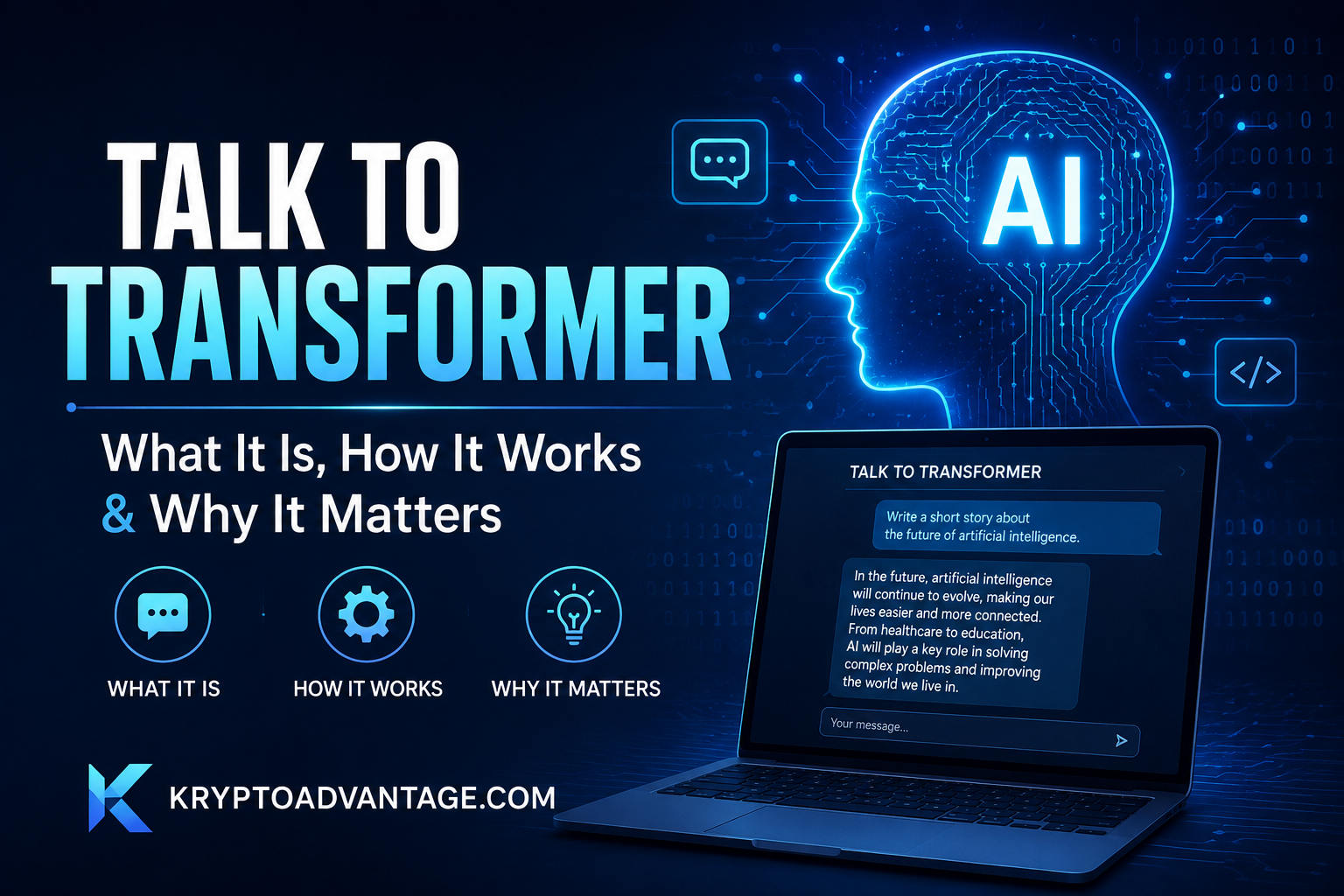
What Was Talk to Transformer?
Talk to Transformer was a free website built by developer Adam King. It launched in 2019 and let visitors type a starting sentence, then watched an AI model finish the thought.
There was no app to download and no account to create. You visited the site, typed a prompt like “The best pizza in the world is,” and hit a button. Within seconds, the AI wrote several more sentences that sounded surprisingly human.
Why the Name “Transformer”?
The word “transformer” in the name refers to a type of AI architecture, not a robot from a movie. A transformer is a design for neural networks that helps computers understand how words relate to each other in a sentence.
Think of it like a very attentive reader. Instead of reading word by word in a straight line, a transformer looks at an entire sentence at once. It weighs which words matter most to the meaning. This ability is why transformers became the backbone of nearly every major AI text tool that came after, including the large language models used today.
The AI Model Behind It
Talk to Transformer ran on GPT-2, a language model built by OpenAI. GPT-2 was trained on roughly eight million web pages, so it had absorbed patterns from a huge amount of human writing.
At the time, OpenAI was cautious about releasing the full, most powerful version of GPT-2 right away. There were concerns it could be misused to generate fake news or spam at scale, so it was released in stages between February and November 2019. Adam King’s website used an available version to demonstrate what the technology could do, and it quickly went viral.
How Talk to Transformer Worked
Understanding how this tool worked helps you understand how nearly every AI text generator works today. The process is simpler than it sounds.
Step 1: You Give It a Prompt
Everything starts with your input. This could be one word, a sentence, or a full paragraph. The tool called this your “prompt.”
Step 2: The AI Predicts the Next Word
Here’s the core trick. The model doesn’t “know” facts the way a person does. Instead, it predicts the most statistically likely next word, based on patterns it learned during training.
For example, if you type “The cat sat on the,” the model has seen this pattern (or similar ones) many times before. It knows “mat,” “floor,” or “roof” are common next words, so it picks one.
Step 3: It Repeats, One Word at a Time
The AI doesn’t write a full paragraph in one go. It predicts one word, adds that word to the text, then predicts the next word based on the updated sentence. This happens over and over, very fast, until it reaches a stopping point.
This is why AI-generated text can sometimes drift off-topic. Small prediction errors early on can snowball into a sentence that wanders in an odd direction by the end.
Advantages and Disadvantages of Talk to Transformer
No tool is perfect, and this one was an early experiment, not a finished product. Here’s a balanced look at what it did well and where it fell short.
Advantages
- Free and instant access. Anyone could try real AI text generation without paying or waiting.
- No technical skill needed. You didn’t need to know anything about coding or machine learning to use it.
- Genuinely impressive output. For 2019, the text it produced felt far more natural than older prediction tools.
- Educational value. It helped non-experts understand what AI language models could do, years before AI chatbots became common.
Disadvantages
- No fact-checking ability. The model had no way to verify if what it wrote was true.
- Text could drift off-topic. Longer outputs sometimes became repetitive or lost coherence.
- Raised misuse concerns. Critics worried the same technology could generate convincing fake reviews or misinformation.
- Expensive to run for free. The high server costs of running an AI model at scale eventually forced the free version to shut down.
Why Talk to Transformer Mattered
This small website had a bigger impact than its simple design suggested. Here’s why people still talk about it.
It Made AI Feel Real to Everyday People
Before this, most people only read about AI in tech news articles. Talk to Transformer let ordinary readers, students, and writers experience it firsthand. That hands-on moment changed how many people thought about what AI could do.
It Sparked a Public Debate
Because GPT-2 could write convincing fake text, the tool raised real questions. Could this be used to create fake reviews? Fake news? Spam comments that look human? These conversations, which started around Talk to Transformer, are still relevant today as AI text tools have become far more powerful.
It Was an Early Ancestor of Today’s Chatbots
Every popular AI text generator today, including tools used for writing help, coding, and customer support, builds on the same transformer architecture. Talk to Transformer was one of the earliest public demonstrations of this technology, years before AI chatbots became mainstream.
What Happened to Talk to Transformer?
If you try to visit the original website today, you likely won’t find it running the same way. Running an AI model for free, for a large and growing number of visitors, became too expensive for one developer to sustain.
Adam King eventually shut down the free public version around mid-2020. He later built a paid project called InferKit, which offered similar AI text generation as a subscription service aimed at writers and developers. This is a common pattern in early AI tools: a free demo proves the idea works, then the technology moves into a paid product with more resources behind it.
Is There Still a Way to Try It?
You won’t find the exact original experience anymore, but the idea lives on. Many current AI text generator tools let you do the same basic thing: type a prompt, get AI-written text back. The underlying models are now far more advanced than GPT-2, though the core concept traces back to what you can read in this Wikipedia overview of GPT-2.
Talk to Transformer vs. Modern AI Text Generators
It helps to compare the old tool to what’s available now. This shows how much progress has happened in a few short years.
Model Size and Quality
GPT-2 was trained on a large but limited dataset by today’s standards. Modern models are trained on far more data and have far more parameters, which generally means more coherent, accurate, and context-aware writing.
Purpose and Use Cases
Talk to Transformer was mostly a novelty and demo. Today’s AI text generator tools are used for real work: drafting emails, writing code, summarizing documents, brainstorming ideas, and more. If you’re curious how newer AI tools are reviewed and explained in plain language, our App & Software Reviews section covers several of them.
Accuracy and Reliability
Early tools like this one had no real understanding of facts. They just predicted plausible-sounding words. Modern AI tools have improved a lot, but it’s still smart to double-check anything factual an AI writes, since these tools can still make confident-sounding mistakes.
How to Use an AI Text Generator Responsibly
Whether you’re using a modern tool inspired by Talk to Transformer or something more advanced, a few habits go a long way.
- Fact-check anything specific. Names, dates, statistics, and quotes should always be verified elsewhere.
- Use it as a starting point, not a final draft. AI-generated text is often a good rough draft that benefits from a human editing pass.
- Be transparent when it matters. If you’re using AI help for schoolwork or professional writing, check the rules that apply to your situation.
- Watch for repetition or drift. Like the original Talk to Transformer, even modern tools can wander off-topic in longer outputs.
FAQ
What is Talk to Transformer used for?
Talk to Transformer was used to demonstrate how an AI model could complete a sentence or paragraph based on a short prompt. People used it mostly for fun, experimentation, and to see what early AI writing looked like.
Is Talk to Transformer still available?
The original free website is no longer running the way it did in 2019. Its creator later launched a paid tool called InferKit, and many newer AI text generator tools now offer similar or more advanced features.
What AI model powered Talk to Transformer?
It used GPT-2, a language model built by OpenAI and released in 2019. GPT-2 was trained on a large collection of text from the internet to learn patterns in human writing.
Is an AI text generator accurate?
Not always. AI text generators predict likely-sounding words rather than verifying facts, so they can produce text that sounds confident but is incorrect. Always double-check important details before trusting or sharing AI-written content.
How is a transformer different from older AI models?
Older language models processed text mostly in a straight line, word by word, which made it harder to capture long-range connections between words. Transformers process entire chunks of text together, which helps them better understand context and relationships between words far apart in a sentence.
Conclusion
Talk to Transformer was a small website with a big impact. It gave everyday people their first real taste of AI-generated writing, sparked important conversations about the risks and benefits of the technology, and paved the way for the AI text generator tools we use every day now.
The original tool may be gone, but its legacy is everywhere. If you’re curious to see how far this technology has come, try out a modern AI writing tool and compare the results for yourself.
Disclaimer: This article is for general informational and educational purposes only. It does not constitute professional, technical, or investment advice. AI tools mentioned here may change, shut down, or update their features over time, and product details (pricing, availability, ownership) should be verified directly with the provider before you rely on them.